Ukrajina
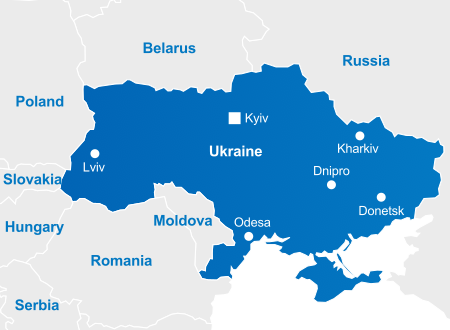
A country endowed with natural resources and high-quality soil, with agricultural land covering nearly 70% of its territory.
Total area: 603,550 sq km (slightly smaller than Texas)
Population: 36.7 million
Government type: Unitary semi-presidential constitutional republic
Administrative division: Crimea Autonomous Republic, 24 provinces (called „oblast“), and 2 cities with special status
Capital + other major cities: Kyiv (Kiev) (2.80 million) + Kharkiv (1.43 million), Dnipro (1.03 million), Donetsk (1.02 million), Odesa (1.0 million)
Currency: hryvnia (UAH)
Languages: Ukrainian (official) 67%, Russian 24%, plus minorities speaking Romanian, Polish, and Hungarian
Ethnicity: Ukrainian 77.8%, Russian 17.3%, Belarusian 0.6%, Moldovan 0.5%, Crimean Tatar 0.5%, Bulgarian 0.4%, Hungarian 0.3%, Romanian 0.3%, Polish 0.3%, Jewish 0.2%, other 1.8%
Religion: Ukrainian Orthodox 50%; Ukrainian Greek Catholic 8-10%; Ukrainian Autocephalous Orthodox 1-2%; Roman Catholic, Protestant, Muslim, Jewish (<1% each)
President: (Mr.) Volodymyr ZELENSKY (since 20 May 2019)
Prime Minister: (Ms.) Yulia SVYRYDENKO (since July 2025)
KEY FEATURES
- The largest country in Europe
- Large consumer market
- Strong heavy-industry base
- Major global exporter of iron ore
- Strategic location linking EU markets with Asia
- Known as the “Breadbasket of the World”, a major exporter of grain and sunflower oil
- EU candidate country
- Seeking OECD membership
- Ongoing military conflict with Russia since 2014
MACROECONOMIC OVERVIEW
In the pre-war period, Ukraine has faced persistent structural challenges, including high inflation, labor outflows, widespread corruption, and a business environment weakened by an underdeveloped rule of law. Its economic development was severely disrupted by the 2014 political crisis, followed by the illegal annexation of Crimea by the Russian Federation and armed conflict in eastern Ukraine, the country’s most industrially productive region.
Economic activity was further disrupted by the full-scale Russian invasion in February 2022, which impacted virtually all sectors and caused a 29% decline in GDP that year. The economy began to rebound in 2023, with GDP growth projected at 2.2% in 2025, supported by strong performance in agriculture and manufacturing, resilient consumer demand, and government spending. Inflation remains elevated at around 10%, and the labor market continues to face shortages due to war-related disruptions and population displacement. GDP per capita remains very low compared with other EU countries, at just 28% of the EU average, reflecting the combined effects of conflict, underinvestment, and structural inefficiencies.
Ukraine’s economic outlook remains highly uncertain and heavily dependent on the course and duration of the ongoing military conflict, which is expected to have lasting economic, social, and humanitarian consequences.
Selected economic indicators, Ukraine, 2017 - 2024*
| 2018 | 2019 | 2020 | 2021 | 2022 | 2023 | 2024 | ||
| GDP |
|
|
|
|
|
|
|
|
| Real GDP growth |
%
|
3.5 | 3.2 | -3.8 | 3.4 | -28.8 | 5.3 | 2.9 |
| GDP at current prices |
€ bn
|
111.20 | 123.085 | 142.24 | 183.94 | 127.66 | 150.6 | 151.5 |
| Foreign trade |
|
|
|
|
|
|
|
|
| Exports |
€ bn
|
39.9 | 44.6 | 42.8 | 55.8 | 41.7 | 32.9 | 38.4 |
| Imports |
€ bn
|
48.6 | 54 | 46.7 | 59.4 | 51.9 | 57.8 | 65.1 |
| Balance |
€ bn
|
-8.7 | -9.4 | -3.9 | -3.6 | -10.2 | -24.9 | -26.7 |
| Prices |
|
|
|
|
|
|
|
|
| CPI – average inflation rate |
%
|
11 | 7.9 | 2.7 | 9.4 | 20.2 | 12.9 | 6.5 |
| PPI – industry – average |
%
|
14.2 | -7.4 | 14.5 | 62.2 | n/a | 16.2 | 27.6 |
| Employment |
|
|
|
|
|
|
|
|
| Registered unemployment |
%
|
8.8 | 8.2 | 9.2 | 9.8 | 24.5 | 19.1 | 13.1 |
| Average monthly gross wage |
€
|
276 | 392 | 391 | 434 | 435 | 402 | 493 |
| Exchange rates |
|
|
|
|
|
|
|
|
| USD/UAH average (UAH per USD) |
|
27.19 | 25.79 | 26.97 | 27.28 | 32.64 | 36.8 | 40.17 |
| EUR/UAH average (UAH per EUR) |
|
32.11 | 29.02 | 30.84 | 32.28 | 34.25 | 39.8 | 43.47 |
*Excluding the temporarily occupied territories, the Autonomous Republic of Crimea and the city of Sevastopol.
State Statistics Committee of Ukraine, Ministry of Economics of Ukraine, European Commission, IMF, UN Comtrade, 2017-2024
KEY SECTORS
The agricultural sector remains a cornerstone of Ukraine’s economy, making a significant contribution to GDP growth. Agri-food exports account for nearly 55% of total export earnings and around 8% of GDP, sustaining the sector despite the fact that almost one-fifth of Ukraine’s agricultural land is land-mined or otherwise unsafe for use.
The industrial sector, including mining and energy, accounts for approximately 19% of GDP, with manufacturing contributing about 8.5%. Ukrainian manufacturing is dominated by heavy industries, particularly iron and steel production.
The service sector is the largest component of Ukraine’s economy, accounting for approximately 61% of GDP and employing a similar share of the workforce. It has remained relatively resilient despite the ongoing military conflict, as it is less directly affected by physical destruction. Ukraine’s banking sector has also demonstrated notable resilience during this period.
Agrifood sector
Ukraine’s agricultural strength is underpinned by its vast land resources and highly fertile soils called chernozem, which cover approximately two-thirds of the country. Ukraine is the world’s fifth-largest exporter of cereals and a major producer of rapeseed, barley, corn, poultry, and sunflower oil, positioning the country as a key global food supplier. It is often referred to as the “breadbasket of the world,” as it provides essential food supplies to hundreds of millions of people, particularly in Africa, the Middle East, and Asia.
Iron and Steel industries
Ukraine’s industrial sector has long been dominated by heavy industries, particularly the iron and steel sectors. Even after Russia’s invasion and the occupation of the industrially rich eastern regions, the sector continues to account for 7.2% of GDP and represents 15% of goods exports. Ukraine ranks among the top five largest exporters of iron ore, reflecting its substantial natural resource base.
The industry has been one of the hardest hit by the war, with exports significantly disrupted and logistics and transportation costs rising due to the conflict. The sector remains critical for defense-industrial manufacturing, including the production of drones and armored vehicles.
Mining
Ukraine is one of the world’s most important mineral-producing countries, holding approximately 5% of global mineral resource reserves. The country has nearly 20,000 identified mineral deposits encompassing 117 types of metals and minerals, including 22 critical raw materials as designated by the European Union. Ukraine accounts for around 7% of global titanium production and ranks first in Europe in reserves of iron ore, manganese, and uranium. It also possesses substantial reserves of coal, natural gas, nickel, and rare earth elements, as well as one of Europe’s largest confirmed lithium deposits. Ukraine also holds Europe’s third-largest shale gas reserves, estimated at around 1.2 trillion cubic meters. The Dnieper–Donetsk basin alone contains roughly 80% of the country’s known conventional oil, gas, and coal reserves. Many of the most resource-rich areas are located in eastern Ukraine, much of which is currently under Russian control. Since the onset of the war, oil production has declined sharply, while gas production has increased for two consecutive years despite the ongoing conflict.
ICT
Ukraine’s IT sector remains a cornerstone of the national economy and its most resilient export industry, maintaining stability and growth even after the Russian invasion. The sector employs approximately 300,000 specialists and contributes roughly 4% of GDP, with the country boasting the highest number of IT graduates in the region. IT services account for 42% of all service exports, with top clients including the U.S., the UK, Germany, Switzerland, Israel, and Poland.
The Ukrainian IT industry is increasingly focused on artificial intelligence, cybersecurity, and DefenseTech, a rapidly growing field since the invasion. Approximately 25% of investment transactions in 2024 were directed to the DefenseTech sector. Startups and companies in this sector are developing drones, electronic warfare systems, and AI navigation systems.
Chemical industry
Ukraine’s multi-branch chemical sector, encompassing fertilizers, chemicals, petrochemicals, and pharmaceuticals, accounts for nearly 3.5% of GDP and employs around 5% of the industrial workforce. Historically, Donbas hosted the largest number of chemical enterprises, including the country’s biggest plants. Following the outbreak of the war, many enterprises have suspended production, particularly in zones of hostilities and occupied territories.
The industry is now divided between high-performing pharmaceutical plants and recovering fertilizer giants. A major milestone occurred in 2025, when the Ukraine REACH regulation officially came into force. This law bridges the gap between the Ukrainian and European markets, facilitating the export of Ukrainian chemical products to the EU.
Energy
Historically, Ukraine has had a strong energy sector, including oil and gas, coal, hydroelectric, nuclear, and renewable energy industries, which together accounted for 7.6% of GDP. Before the war, Ukraine’s electric power system included over 30 major power plants, including four nuclear plants.
Before the Russian invasion, renewable energy was expanding, reaching 11% of generation capacity. Since 2022, Ukraine has been integrated into the European ENTSO-E electricity transmission system, improving grid stability.
The war has heavily affected the energy sector, destroying many thermal and hydroelectric plants and capturing some energy facilities, including Europe’s largest Zaporizhzhia Nuclear Power Plant in 2022. As of early 2026, repeated attacks on power plants, transmission grids, and gas infrastructure continue to disrupt the sector.
EXPORTS & IMPORTS
Ukraine’s trade deficit has reached record levels, with imports more than doubling the value of exports in 2025. The composition of imports has shifted toward defense technology, machinery, and energy equipment, followed by chemicals and fuel. Exports are dominated by food products, while the share of metals and machinery has declined.
Following the full-scale invasion, trade with Russia has been completely halted. The European Union has become Ukraine’s primary trading partner, accounting for nearly 60% of total trade turnover. Although Ukraine has achieved independence from Russian gas, high-volume natural gas imports continue to be a significant contributor to the structural trade deficit.
2024 export and import data
Main import partners:
China – 20.3%
Poland – 9.9%
Germany – 7.6%
Türkiye – 6%
USA – 4.9%
Main export partners:
Poland – 11.3%
Spain – 6.9%
Germany – 6.8%
China – 5.7%
Türkiye – 5.3%
Market Research in Ukraine
EasyLink provides professional expertise in strategic market research, market intelligence, competitive intelligence, market size analysis and market potential evaluation, competitive landscape and distribution structure study, identification of new customers and potential partners etc. Please contact us to discuss how we can assist your business objectives in export, marketing or sourcing.
Customer Search & Partner Search in Ukraine
We are experienced experts in matchmaking projects involving the search, identification, screening and pre-selection of business partners in Central & Eastern Europe, ranging from distributor search to profiling of prospective customers and identifying specific business opportunities; we assist our clients with sourcing in emerging markets and low-cost markets in the CEE region.
International Trade Consultancy – Export, Marketing and Trade Promotion in Ukraine and the CEE region
EasyLink has a unique track record in international trade promotion. With local consultants in all key markets in Central & Eastern Europe, EU markets and some overseas markets, we provide customized market research, develop trade opportunities with prospective partners and new customers, and assist clients with strategic advice for their export, marketing and sourcing needs.