Turecko
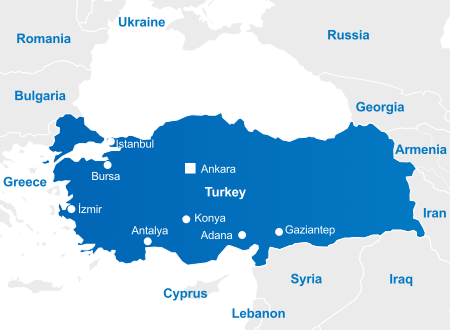
Situated at the crossroads of Europe and Asia, Turkey blends cultural influences from both continents
Total area: 783,562 sq km
Population: 85.8 million
Government type: Presidential republic
Administrative division: 81 provinces (called “iller”)
Capital + other major cities: Ankara (capital; 5.7 million), Istanbul (15.9 million), Izmir (4.4 million), Bursa (3.2 million), Antalya (2.7 million)
Currency: Turkish lira
Languages: Turkish (official), Kurdish
Ethnicity: Turks 70-75%, Kurds 19%, other minorities 6-11% (Arabic, Zazaki, Armenian)
Religion: Muslim (99.9%)
President: (Mr.) Recep Tayyip ERDOĞAN (since 28 August 2014). Since 2018, serving also as head of government following a constitutional amendment.
Date of EU accession: Official candidate country since 1999
KEY FEATURES
- From 2022 formally known as Türkiye
- Geostrategic location between Europe and Asia
- Second-largest military force in NATO after the United States
- Applied for EU membership as early as 1986
- Islam is the predominant religion
- Young population (21% of people under the age of 15)
- Member of the G20
- The Middle East’s leading steel producer
MACROECONOMIC OVERVIEW
Turkey is a strategically located economy, serving as a critical bridge between Europe and Asia. Turkey’s geopolitical position, situated between Europe, the Middle East, and Central Asia, plays a significant role in shaping its economy by influencing trade relations and foreign policy decisions. It ranks as the world’s 16th largest economy by nominal GDP. The country has a diversified economic structure, with strong activity across manufacturing, services, agriculture, and construction, which reduces dependence on any single sector and enhances resilience to external shocks.
Economic growth has been volatile but relatively strong over the long term, averaging around 5–7% during the first decades of the 21st century. Growth slowed in 2024, reflecting weaker consumption and investment amid elevated inflation and high interest rates. GDP growth is projected to reach approximately 3.4% in 2026, indicating a more moderate but stable expansion compared with historical averages.
Inflation has remained a persistent macroeconomic challenge. After years of recurring double-digit inflation, price pressures intensified sharply and peaked at 72.3% in 2022. Following the implementation of a tight monetary policy and significantly higher interest rates, inflation eased to around 35% in 2025. The disinflation trend is expected to continue, although price stability remains fragile. Structural issues, including high inflation volatility, low productivity growth, and weakening foreign direct investment, continue to undermine Turkey’s long-term growth potential.
Despite these challenges, Turkey remains an attractive investment destination due to its large domestic market, diversified economy, and strategic location. FDI inflows have been concentrated primarily in manufacturing, energy, and real estate.
Macroeconomic conditions have also been affected by external shocks. In early 2023, two major earthquakes struck southeastern Turkey, causing more than 50,000 casualties and destroying nearly 2 million housing units. Large-scale reconstruction efforts are expected to support economic activity in the coming years, providing a significant boost to Turkey’s already rapidly expanding construction sector.
Selected economic indicators, Turkey, 2018 - 2024
| 2018 | 2019 | 2020 | 2021 | 2022 | 2023 | 2024 | ||
| GDP |
|
|
|
|
|
|
|
|
| Real GDP growth |
%
|
3.0 | 0.8 | 1.9 | 11.4 | 5.4 | 5.0 | 3.3 |
| GDP at current prices |
€ bn
|
658.9 | 679.1 | 626.7 | 690.2 | 862.3 | 1,020 | 1,220 |
| Foreign trade |
|
|
|
|
|
|
|
|
| Exports |
€ bn
|
205.8 | 224.6 | 182.5 | 246.7 | 332.7 | 329.1 | 342.3 |
| Imports |
€ bn
|
206.7 | 204.5 | 201.9 | 243.9 | 367.2 | 353.8 | 338.9 |
| Balance |
€ bn
|
-0.9 | 20 | -19.4 | 2.8 | -34.5 | -24.7 | 3.4 |
| Prices |
|
|
|
|
|
|
|
|
| CPI – average inflation rate |
%
|
16.3 | 15.2 | 12.3 | 19.6 | 72.3 | 53.9 | 58.5 |
| PPI – industry – average |
%
|
27.0 | 17.6 | 12.1 | 43.9 | 128.5 | 49.9 | 41.1 |
| Employment |
|
|
|
|
|
|
|
|
| Registered unemployment |
%
|
10.9 | 13.7 | 13.2 | 12.0 | 10.5 | 9.4 | 8.8 |
| Average monthly gross wage* |
€
|
694 | n/a | 503 | n/a | 565 | n/a | 743 |
| Exchange rates** |
|
|
|
|
|
|
|
|
| USD/TRY average (TRY per USD) |
|
4.84
|
5.68
|
7.019
|
8.89
|
16.57
|
23.81
|
32.88
|
| EUR/TRY average (TRY per EUR) |
|
5.70
|
6.35
|
8.05
|
10.51
|
17.40
|
25.78
|
35.58
|
Source: Eurostat, International Monetary Fund, Turkish Statistical Institute, ECB, OECD, Trading Economics, 2018-2025
* The Turkish Statistical Institute monitors this type of data at quadrennial intervals.
** For the current exchange rate, please see www.xe.com
KEY SECTORS
Turkey’s economy reflects a blend of modern industries, traditional sectors, and ongoing efforts to adapt to global economic changes.
Although agriculture’s contribution to GDP has declined to 6.5% over the years, it remains an important sector, particularly for employment, providing jobs for around 15% of the workforce according to World Bank statistics.
The country has a robust export-oriented industrial sector, accounting for 32% of GDP, with key industries including automotive, textiles, machinery, electronics, and consumer goods. The service sector is the largest contributor to the economy, representing 58% of GDP and covering finance, tourism, healthcare, education, and other areas. Tourism plays a particularly important role, benefiting from Turkey’s rich historical heritage and attractive coastal destinations.
Automotive
Turkey is a major car manufacturer in Europe, with a robust automotive industry that includes manufacturing and exports of vehicles and components. Major automotive manufacturers in the country include Ford, Renault and Toyota. Other major plants include Fiat, Hyundai Assan, and Mercedes-Benz (Buses/Trucks). The whole industry directly employs more than 500,000 people. Turkey ranks 12th in global vehicle production and 4th in Europe with the approximate production of 1.4 million vehicles per year. The 30 of the top 50 automotive suppliers have their production facilities in the country. The country’s electric vehicle (EV) market has expanded rapidly in recent years. A key driver of this growth is TOGG, Türkiye’s first domestically developed EV brand, which has quickly gained market share and become a leading EV seller. In addition, Chinese manufacturers such as BYD are planning local production.
Textiles & Apparel
The textile and clothing industry has long been an important contributor to Turkey's economy, contributing on average about 7% to GDP. A significant exporter of textiles, apparel, and fashion products, the sector has traditionally benefited from Turkey’s long-standing textile heritage, competitive labor costs, and proximity to major markets in Europe and the Middle East.
Turkey ranks as the 6th largest apparel exporter globally and 3rd in Europe. However, rising labor costs and intense competition from Asian producers have created structural challenges for the sector. To maintain its market position, the industry will need to shift from mass production toward higher value-added products.
Agriculture and Food sector
Turkey benefits from a diverse climate and varied geographical regions, which enable the cultivation of a wide range of crops, including grains, fruits, and vegetables, alongside strong poultry and dairy production. The country is also a significant producer of nuts and pulses. Largely self-sufficient in most agricultural products, Turkey is a major exporter of agricultural goods, particularly hazelnuts, accounting for around 60% of global supply, as well as figs, apricots, and dried fruits, for which it is the world’s leading producer and exporter.
Turkey ranks among the world’s top 10 agricultural producers. The food industry is the second-largest manufacturing sector in the country after the automotive industry.
Home appliances
The home appliance industry in Turkey covers a wide spectrum of products, including white goods (refrigerators, washing machines, dishwashers), small appliances (coffee makers, vacuum cleaners), and household electronics. The country is the second-largest producer of white goods in the world after China, followed by the U.S. and Poland, and exports approximately 75% of its production, primarily to Europe. The market leader is the Turkish company Arçelik, which owns brands such as Grundig and Beko and employs around 55,000 people worldwide across 14 countries.
Defense
Over the last decade, Turkey has heavily invested in its domestic defense industry to reduce reliance on foreign defense imports and strengthen its global position. By 2026, Turkey had become a global leader in drone technology and armored vehicles, with defense exports reaching record highs and contributing significantly to the reduction of the current account deficit. The sector employs nearly 100,000 people, and Turkey is ranked as the world’s 11th largest arms exporter, holding a 1.7% share of the global market.
EXPORT & IMPORT
Turkey is less dependent on international trade due to its strong domestic market. The ratio of exports of goods and services to GDP stands at 28%. Supported by a large domestic market of 86 million people, Turkey has successfully pursued a strategic shift toward export-led growth to stabilize its economy and generate foreign currency inflows. The country has a well-developed export base, particularly in the automotive, chemicals, machinery, and textiles sectors. Defense and aerospace exports expanded at an average annual rate of nearly 30% between 2020 and 2025. The EU remains Turkey’s largest trading partner.
2024 export and import data:
Main import partners:
China – 13.1%
Russian Federation – 12.8%
Germany – 7.9%
Italy – 5.6%
Special Categories – 5.2%
Main export partners:
Germany – 7.8%
USA – 6.2%
United Kingdom – 5.8%
Iraq – 5%
Italy – 4.9%
Market Research in Turkey
EasyLink provides professional expertise in strategic market research, market intelligence, competitive intelligence, market size analysis and market potential evaluation, competitive landscape and distribution structure study, identification of new customers and potential partners etc. Please contact us to discuss how we can assist your business objectives in export, marketing or sourcing.
Customer Search & Partner Search in Turkey
We are experienced experts in matchmaking projects involving the search, identification, screening and pre-selection of business partners in Central & Eastern Europe, ranging from distributor search to profiling of prospective customers and identifying specific business opportunities; we assist our clients with sourcing in emerging markets and low-cost markets in the CEE region.
International Trade Consultancy – Export, Marketing and Trade Promotion in Turkey and the SEE region
EasyLink has a unique track record in international trade promotion. With local consultants in all key markets in Central & Eastern Europe, EU markets and some overseas markets, we provide customized market research, develop trade opportunities with prospective partners and new customers, and assist clients with strategic advice for their export, marketing and sourcing needs.