Srbsko
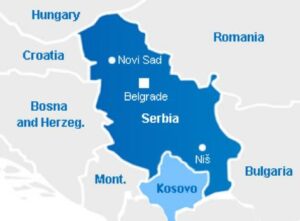
Strategic location in the heart of Southeast Europe
A bridge between East and West
Strong FDI inflows from the EU, Germany, and China
Total area: 77,589 sq. Km (roughly the size of Nebraska)
Population: 6.6 million (without Kosovo)
Government type: Parliamentary republic
Administrative division: Excluding Kosovo: 138 municipalities (opštine) and 23 cities (gradovi). Apart from municipalities, there are also 24 districts (okruzi), with the City of Belgrade constituting an additional district. Serbia has two autonomous provinces (autonomne pokrajine): Vojvodina in the north and claims Kosovo and Metohija in the south.
Capital + other major cities: Belgrade (1.3 million) + Novi Sad (306,000), Nis (182,000), Kragujevac (146,000), Subotica (94,000)
Currency: Serbian dinars (RSD)
Languages: Serbian (official) 88.1%, Hungarian 3.4%, Bosnian 1.9%, Romany 1.4%, other 3.4%, undeclared or unknown 1.8%
Ethnicity: Excl. Kosovo: Serb 80.7%, Hungarian 2.8%, Romany 2.0%, Bosniak 2.3%, other 5.7%, undeclared or unknown 3.4%, in Kosovo 93% are Albanian
Religion: Excl. Kosovo: Serbian Orthodox 84.6%, Catholic 5%, Muslim 3.1%, Protestant 1%, atheist 1.1%, other 0.8%, undeclared or unknown 4.5%; in Kosovo 95.6% of population is Muslim
President: (Mr.) Aleksandar VUCIĆ (since 31 May 2017)
Prime Minister: (Mr.) Đuro MACUT (since 16 April 2025)
Date of EU accession: Official candidate country since March 2012
KEY FEATURES
- Second-largest market in Southeast Europe
- Key intersection of major European transport corridors
- Both the Cyrillic and Latin alphabets are used
- Kosovo declared independence from Serbia in 2008, a move Serbia does not recognize
- Relations with Kosovo remain a source of regional tension in the Western Balkans
- Experiencing a boom in wind energy development
- Highest inflow of FDI in the Western Balkans
- The Jadar Valley deposit is considered Europe’s largest high-quality lithium source.
- Will host the EXPO in 2027
- Not a member of the WTO
MACROECONOMIC OVERVIEW
Located in the heart of Southeast Europe and bordering the EU, Serbia continues to benefit from its strategic position as a key transit and production hub linking West with East. After decades of transition following the 1990s, Serbia has achieved a relatively stable macroeconomic framework, with growth averaging solid levels in recent years, though it slowed to around 2% in 2025 amid weaker external demand and domestic political uncertainty, following stronger growth of nearly 4% in 2024. The economy used to be largely driven by manufacturing, exports, and foreign direct investment. However, the services sector, namely ICT, has gained increasing importance in recent years and is currently serving as the country’s largest net exporting industry.
Private consumption remains the main driver of GDP growth, whereas a persistent trade deficit continues to weigh on the external balance, though it is largely financed by FDI inflows. Inflation has moderated, supported by prudent monetary policy, while public finances remain broadly stable, with a moderate fiscal deficit and public debt below 50% of GDP. Unemployment has fallen significantly over the past decade to around 8-9%, but it remains above the EU average. Serbia is suffering from a severe shortage of skilled workers. Although Serbia demonstrated notable resilience during the COVID-19 pandemic, significant structural challenges remain, particularly the large role of the state sector, ongoing demographic pressures, and the need for further institutional and governance reforms, many of which are closely linked to Serbia’s EU accession process.
One of the key geopolitical and economic challenges is the ownership structure of NIS, the country’s largest oil and gas company and sole refinery operator. As the company is majority-owned by Russia’s Gazprom, it has been exposed to U.S. sanctions imposed in response to the war in Ukraine. This situation highlights a broader geopolitical strain, as Serbia seeks to preserve its historically close ties with Russia and ensure energy security, while simultaneously attempting to avoid U.S. secondary sanctions and maintain the smooth functioning of its economy.
Selected economic indicators, Serbia, 2018 - 2024
| 2018 | 2019 | 2020 | 2021 | 2022 | 2023 | 2024 | ||
| GDP |
|
|
|
|
|
|
|
|
| Real GDP growth |
%
|
4.5 | 4.3 | -0.9 | 7.7 | 2.7 | 3.7 (p) | 3.9 |
| GDP at current prices |
€ bn
|
42.86 | 46.0 | 46.79 | 53.33 | 63.5 (p) | 75.2 (p) | 82.32 |
| Foreign trade |
|
|
|
|
|
|
|
|
| Exports |
€ bn
|
21.76 | 23.85 | 22.57 | 29.0p | 38.57 | 41.62 | 44.62 |
| Imports |
€ bn
|
25.41 | 27.87 | 26.45 | 33.18p | 45.20 | 44.75 | 48.37 |
| Balance |
€ bn
|
-3.65 | -4.02 | -3.87 | -4.18p | -6.6 | -3.13 | -3.75 |
| Prices |
|
|
|
|
|
|
|
|
| CPI – average inflation rate |
%
|
2.0 | 1.9 | 1.6 | 4.1 | 12.0 | 12.4 | 4.7 |
| PPI – industry – average |
%
|
2.4 | 0.7 | -1.7 | 9.0 | 17.0 | 3.3 | 1.7 |
| Employment |
|
|
|
|
|
|
|
|
| Registered unemployment |
%
|
13.8 | 11.3 | 9.8 | 11.1 | 9.4 | 9.5 | 8.6 |
| Average monthly gross wage |
€
|
583 | 705 | 707 | 774 | 881 | 1,011 | 1,156 |
| Exchange rates* |
|
|
|
|
|
|
|
|
| USD/RSD average (RSD per USD) |
|
100.18 | 105.25 | 103.16 | 99.39 | 111.66 | 108.41 | 112.43 |
| Currency board fixed rate: EUR/RSD |
|
118.27 | 117.85 | 117.57 | 117.57 | 117.45 | 117.25 | 117.01 |
Source: Statistical Office of the Republic of Serbia, National Bank of Serbia, IMF, Eurostat, 2018-2025
* For the current exchange rate, please see www.xe.com
KEY SECTORS
Serbia remains the leading food exporter in the Western Balkans, with agriculture accounting for approximately 6.5% of GDP and employing around 15-19% of the workforce.
Serbian industry today represents a diversified economic base, combining agriculturally fertile land with a long-standing manufacturing tradition. Historically oriented toward cooperation with Western European partners, Serbia’s key industrial sectors include base metals, food processing, electronics, and the automotive industry. In recent years, the industrial landscape has increasingly been shaped by the green transition and the growing production of higher value-added and high-tech components.
Alongside industry and agriculture, the service sector plays an increasingly important role in the Serbian economy, accounting for the largest share of GDP and employment. Serbia has developed a competitive ICT sector with strong export performance, supported by a skilled workforce, competitive costs, and growing foreign investment.
The country outperforms most regional peers in attracting FDI relative to the size of its economy, with the EU being the main sources of investment. In parallel, China has made substantial investments in Serbia, primarily concentrated in the mining and heavy industrial sectors.
Automotive industry
The automotive sector remains a cornerstone of the Serbian economy, comprising over 130 companies and employing more than 100,000 people in vehicle production and component manufacturing. The industry supplies nearly all major European car manufacturers as well as several Asian producers, and its focus has gradually shifted from basic chassis components to high-tech electronics and other advanced automotive systems. Stellantis is the country’s primary passenger car manufacturer, operating a major assembly plant in Kragujevac that now produces electric vehicles as part of its modernization efforts. Serbia is also a global hub for tire exports, and the Serbian company ElevenEs is finalizing a large-scale factory in Subotica to produce lithium iron phosphate (LFP) batteries, representing Europe’s first LFP battery gigafactory.
ICT
The ICT sector has solidified its position as a key pillar of the Serbian economy and its largest net-exporting industry. It is home to over 4,000 innovative companies and a workforce of approximately 115,000 professionals renowned for their high-value technical skills. This talent pool has been further strengthened by the immigration of IT specialists from Russia and Belarus since 2022. These professionals, bringing senior expertise in AI, gaming, and cloud architecture, have significantly boosted the local ICT sector following the onset of the Russia-Ukraine war.
Agri-food sector
The food processing sector is a traditional and stable pillar of Serbia’s industry. The combined agri-food sector accounts for approximately 10% of Serbia’s GDP and plays a dominant role in external trade, representing around 15% of total goods exports. Its strong performance is supported by a diverse portfolio, including global leadership in frozen fruits, particularly raspberries and blackberries, as well as a significant regional presence in confectionery, beverages, and oilseed processing. Despite recent challenges from extreme weather, the industry is undergoing a digital transformation, incorporating AgTech solutions and AI-driven processing to maintain its competitiveness as Serbia’s leading net-exporting goods sector.
Metal-processing and machine-building industry
The metal-processing and machine-building industry remains a core pillar of the Serbian economy, accounting for nearly 20% of national exports. Large-scale companies dominate primary metal processing, while the sector is supported by a specialized network of SMEs, which make up around 90% of the manufacturing subsector. After years of underinvestment, the mining sector has become a major recipient of foreign direct investment, particularly from China, driven by substantial copper and gold operations in eastern Serbia. The industry is guided by a new National Mineral Strategy, which emphasizes the development of critical raw materials. However, the high-profile Jadar Lithium Project is currently on hold. Despite its designation as an EU Strategic Project, its progress continues to be constrained by significant domestic environmental concerns and a slow permitting process.
EXPORTS & IMPORTS
While Serbia continues to run a structural trade deficit in goods, largely driven by imports of energy and investment-grade machinery, the government has successfully guided the economy toward an export-oriented model. The country demonstrates high trade openness, with exports of goods and services accounting for over 50% of GDP. The European Union remains the primary destination, but Serbia has also achieved significant diversification through growing trade with China and the United States. Notably, the expansion of the ICT and automotive sectors is reshaping the country’s trade profile and increasing its share of high-value exports.
2024 export and import data:
Main import partners:
China – 13.1%
Germany – 13.1%
Italy – 7.1%
Türkiye – 5.3%
Hungary – 4.3%
Main export partners:
Germany – 15.5%
Bosnia Herzegovina – 6.4%
China – 5.9%
Italy – 5.7%
Hungary – 4.7%
Market Research in Serbia
EasyLink provides professional expertise in strategic market research, market intelligence, competitive intelligence, market size analysis and market potential evaluation, competitive landscape and distribution structure study, identification of new customers and potential partners etc. Please contact us to discuss how we can assist your business objectives in export, marketing or sourcing.
Customer Search & Partner Search in Serbia
We are experienced experts in matchmaking projects involving the search, identification, screening and pre-selection of business partners in Central & Eastern Europe, ranging from distributor search to profiling of prospective customers and identifying specific business opportunities; we assist our clients with sourcing in emerging markets and low-cost markets in the CEE region.
International Trade Consultancy – Export, Marketing and Trade Promotion in Serbia and the CEE region
EasyLink has a unique track record in international trade promotion. With local consultants in all key markets in Central & Eastern Europe, EU markets and some overseas markets, we provide customized market research, develop trade opportunities with prospective partners and new customers, and assist clients with strategic advice for their export, marketing and sourcing needs.