Litva
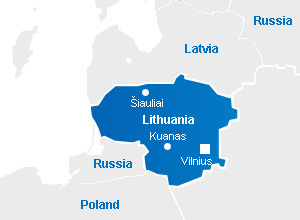
The largest of the three Baltic republics with the biggest economy, generating roughly half of the region’s GDP
Most diversified industry in the Baltics
Total area: 65,286 sq km (slightly larger than Switzerland or West Virginia)
Population: 2.9 million
Government type: Parliamentary democracy
Administrative division: 10 counties (called „apskritys“) further subdivided into 60 municipalities (called “savivaldybe”)
Capital + other major cities: Vilnius (580,000) + Kaunas (289,000), Klaipeda (149,000), Šiaulilai (101,000)
Currency: Euro (since January 2015)
Languages: Lithuanian (official) 85.3%, Russian 6.8%, Polish 5.1%, other 0.9%, unspecified 3.5%
Ethnicity: Lithuanian 84.6%, Polish 6.5%, Russian 5.0%, Belarusian 1.0%, other 1.1%, unspecified 1.2%
Religion: Roman Catholic 77.2%, Russian Orthodox 4.1%, Old Believer 0.8%, Evangelical Lutheran 0.6%, Evangelical Reformist 0.2%, other 0.8%, none 6.1%, unspecified 10.1%
President: (Mr.) Gitanas NAUSEDA (since 12 July 2019)
Prime Minister:(Mr.) Rimantas ŠADŽIUS (since 4 August 2025)
Date of EU accession: 1 May 2004
KEY FEATURES
- The largest and most populous of the Baltic countries
- Personal income tax and corporate tax rates (15%) among the lowest in the EU.
- Lasers and biotechnology are key areas of Lithuania’s science and high-tech industry
- Strong economic ties with neighboring Poland
- Approximately 90% of Lithuanians speak a second language, and 30% of the population holds a university degree.
- Last Baltic country to adopt the euro
MACROECONOMIC OVERVIEW
Lithuania is an open, dynamic, and fast-developing economy, strategically positioned as a gateway and logistics hub between the Nordic-Baltic region and Central Europe. Since joining the EU in 2004, the country has transformed from a post-Soviet economy into a high-tech knowledge hub, excelling in lasers, biotechnology, and a globally recognized FinTech ecosystem.
Despite recent challenges from the war in Ukraine, which disrupted trade with Russia, and broader geopolitical uncertainty, the economy has demonstrated resilience, supported by strong domestic demand and structural diversification. Economic growth is expected to continue over the medium term. European Commission forecasts project GDP growth of about 3.0% in 2026, supported by robust private consumption and improving investment conditions. Inflation, which rose in 2025 due to food, service, and energy price pressures, is expected to moderate in 2026.
The labor market remains relatively stable. However, demographic challenges, including an aging population, continue to pose structural risks to long-term growth and public finances.
Selected economic indicators, Lithuania, 2018 - 2024
| 2018 | 2019 | 2020 | 2021 | 2022 | 2023 | 2024 | ||
| GDP |
|
|
|
|
|
|
|
|
| Real GDP growth |
%
|
4.0 | 4.7 | 0.0 | 6.3 | 2.5 | 0.7 | 3.0 |
| GDP at current prices |
€ bn
|
45.26 | 48.86 | 49.5 | 56.15 | 67.4 | 73.7 | 78.4 |
| Foreign trade |
|
|||||||
| Exports |
€ bn
|
34.23 | 37.74 | 36.39 | 44.52 | 58.48 | 56.50 | 58.1 |
| Imports |
€ bn
|
33.35 | 35.43 | 31.79 | 42.19 | 59.8 | 53.73 | 54.0 |
| Balance |
€ bn
|
0.88 | 2.4 | 4.59 | 2.32 | -1.32 | 2.76 | 4.1 |
| Prices |
|
|||||||
| CPI – average inflation rate |
%
|
2.5 | 2.2 | 1.1 | 4.6 | 18.9 | 8.7 | 0.9 |
| PPI – industry – average |
%
|
4.2 | 0.7 | -6.6 | 12.8 | 42.0 | -0.3 | -3.1 (p) |
| Employment |
|
|||||||
| Registered unemployment |
%
|
6.2 | 6.3 | 8.5 | 7.1 | 6.0 | 6.9 | 7.1 |
| Average monthly gross wage |
€
|
932 | 1,359 | 1,428 | 1,578 | 1,790 | 2,009 | 2,218 |
Source: Department of Statistics to the Government of the Republic of Lithuania, IMF, OECD, World Bank, Eurostat, 2018-2025
STRUCTURE OF ECONOMY - KEY SECTORS
The agricultural sector contributes 3.2% of the country’s GDP and employs 6.4% of the workforce. More than half of the country’s land area is classified as agricultural land.
The industrial sector accounts for 29.5% of GDP. Lithuania’s well-developed industrial base includes traditional industries such as wood processing, chemicals, machine tools, metal processing, construction materials, and food processing. However, the country has successfully transitioned toward more advanced, high-value manufacturing, including biotechnology, lasers, and electronics. The manufacturing sector is a key pillar of the Lithuanian economy, generating approximately 23% of total GDP, significantly higher than in other Baltic countries.
The services industry as a whole accounts for approximately 65% of the country’s GDP.
Energy & Petrochemical Industry
Lithuania has become a key regional hub for Western crude imports through the Būtingė terminal. The country plays a significant role in petroleum processing thanks to its strategic Mažeikiai refinery, the only refinery in the Baltic States. Refined petroleum products account for 21% of total manufacturing output. The petrochemical cluster is heavily export-oriented, with most of its products destined for Ukraine, Poland, and other Baltic nations.
Food and Beverage industry
The food and beverage industry accounts for 13.6% of Lithuania’s manufacturing output. The sector’s main export strengths include dairy products, meat, grains, and fish, with Lithuania being the EU’s largest exporter of surimi. Agricultural and food products represent 18% of total exports. The industry benefits from a favorable quality to price ratio, the ability to produce in small batches, and Lithuania’s strategic location.
Laser Technology Industry
Lithuania has established itself as a global leader in the laser technology industry, exporting more than 90% of its production to over 90 countries worldwide.
It dominates the market share for high-energy picosecond lasers, and it is also the world leader in Optical Parametric Oscillators (OPOs) production. Lithuanian lasers play a key role in advanced scientific research and but are also essential for the industrial applications such as semiconductor manufacturing.
Life Sciences
Lithuania has emerged as the fastest-growing life sciences hub in Central and Eastern Europe, with the sector now accounting for 2.7% of the national GDP. Over the past three years, the industry has seen a massive 170% revenue increase, largely driven by its shift toward high-value biomanufacturing and advanced therapies. The ecosystem is supported by a workforce of over 15,000 specialists and a strong scientific foundation in gene editing and CRISPR technologies.
FinTech and ICT industry
Lithuania has transitioned toward a robust, knowledge-based economic model, supported by one of the EU’s best-educated workforces in terms of educational attainment. In recent years, the fintech sector has emerged as a key strength. Fintech companies licensed in Lithuania served over 30 million customers in 2024, cementing the country’s position as the EU’s leading fintech hub.
Government efforts to streamline financial regulations and attract foreign startups, alongside the growth of local enterprises, have successfully transformed Vilnius into a regional center for innovative digital finance. Near-universal 5G coverage further reinforces Lithuania’s position as a regional leader in mobile connectivity. The country also boasts a vibrant startup ecosystem and is increasingly recognized as a niche player in quantum technologies.
Wood and Furniture industry
The wood and furniture sector plays a significant role in Lithuania’s economy, accounting for approximately 2.5% of the country’s GDP, one of the highest shares among EU countries. It is the second-largest manufacturing subsector, contributing 15.7% to total industrial output. The country benefits from a favorable resource base, with forests covering nearly one-third of its territory. The sector employs around 30,000 people across approximately 1,000 companies. Lithuania ranks among the top five furniture exporters in Europe, a remarkable achievement given its population of only 2.8 million. The sector continues to make substantial investments in automation and robotics, enhancing its resilience to international competition. Local companies have developed strong global partnerships, particularly with IKEA, which serves as a key partner for many Lithuanian manufacturers.
EXPORTS & IMPORTS
With its open and highly integrated economy, Lithuania is heavily reliant on international trade and therefore exposed to external developments. Exports account for approximately 74% of GDP. At the same time, economic resilience has strengthened through increasing diversification. The European Union remains Lithuania’s primary trading partner, absorbing around 67% of total exports. While traditional sectors such as wood products and furniture remain important, export growth is increasingly driven by high-value activities, including laser technology, biotechnology, and the FinTech services sector.
2024 export and import data:
Main import partners:
Poland – 14%
Germany – 12.5%
Latvia – 8.2%
Norway – 5.3%
Saudi Arabia – 5.1%
Main export partners:
Latvia – 11.9%
Poland – 9.9%
Germany – 8.8%
Netherlands – 6.8%
Estonia – 6%
Market Research in Lithuania
EasyLink provides professional expertise in strategic market research, market intelligence, competitive intelligence, market size analysis and market potential evaluation, competitive landscape and distribution structure study, identification of new customers and potential partners etc. Please contact us to discuss how we can assist your business objectives in export, marketing or sourcing.
Customer Search & Partner Search in Lithuania
We are experienced experts in matchmaking projects involving the search, identification, screening and pre-selection of business partners in Central & Eastern Europe, ranging from distributor search to profiling of prospective customers and identifying specific business opportunities; we assist our clients with sourcing in emerging markets and low-cost markets in the CEE region.
International Trade Consultancy – Export, Marketing and Trade Promotion in Lithuania and the Baltic region
EasyLink has a unique track record in international trade promotion. With local consultants in all key markets in Central & Eastern Europe, EU markets and some overseas markets, we provide customized market research, develop trade opportunities with prospective partners and new customers, and assist clients with strategic advice for their export, marketing and sourcing needs.