Rumunsko
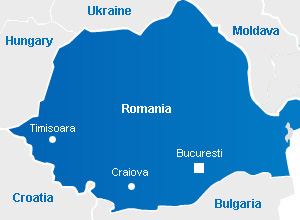
The largest Balkan republic, a country located at the crossroads of Central, Eastern, and Southeastern Europe
Key player in the Black Sea region
Total area: 238,397 sq km (slightly smaller than Oregon)
Population: 19 million
Government type: Unitary semi-presidential republic
Administrative division: 41 counties (called „judete“) and the municipality („municipiu“) of Bucharest
Capital + other major cities: Bucharest (1.7 million) + Cluj-Napoca (286,000), Iasi (271,000), Constanta (263,000), Timisoara (250,000), Brașov (237,000), Craiova (234,000)
Currency: leu (RON)
Languages: Romanian (official) 85.4%, Hungarian 6.3%, Romany 1.2%, other 1%, undeclared 6.1%
Ethnicity: Romanian 89.3%, Hungarian 6.0%, Roma 3.4%, Ukrainian 0.3%, German 0.2%, other 0.7%, undeclared 6.1%
Religion: Eastern Orthodox 85.5%, Reformed 3%, Roman Catholic 4.5%, Pentecostal 2.5%, other 4.5%
President: (Mr.) Nicușor DAN (since 26 May 2025)
Prime Minister: (Mr.) Ilie BOLOJAN (since 23 June 2025)
Date of EU accession: 1 January 2007
KEY FEATURES
- Fast-growing, low-cost manufacturing base in Southeastern Europe
- Largest oil and gas producer in the CEE region
- Abundant natural resources
- The Carpathian Mountains cover approximately one-third of the country
- Strong language skills among Romanian business professionals
- Soon to host the largest NATO military base in Europe
- A full member of the Schengen Area since 2025, following 12 years of negotiations
MACROECONOMIC OVERVIEW
Romania has long benefited from rapid convergence toward the EU average per capita income, and its economic performance has been remarkable. GDP per capita in PPP rose from 38% of the EU average in 2007 to 78% in 2024, reflecting a consistent convergence trend. The period following the Covid-19 downturn saw robust growth in 2021 and 2022, but momentum slowed sharply in 2024, with GDP growth falling to just 0.8%, and only a modest recovery is projected for 2025 and 2026.
This slowdown largely reflects a major fiscal consolidation effort aimed at addressing a budget deficit that peaked at 9.3% in 2024. The government implemented a series of tax increases and subsidy cuts in mid-2025 to comply with EU structural requirements. Inflation, which had previously fallen from double-digit levels, is now rising again, driven by higher prices in the food, energy, and service sectors.
Romania’s long-term economic stability is challenged by a shrinking working-age population, caused by low fertility and ongoing emigration of skilled workers. Despite strong integration into global supply chains, internal vulnerabilities remain, including a low tax-to-GDP ratio, widespread tax evasion, and one of the EU’s largest informal economies. Social disparities remain significant, with approximately 32% of the population at risk of poverty or social exclusion.
Selected economic indicators, Romania, 2018- 2024
| 2018 | 2019 | 2020 | 2021 | 2022 | 2023 | 2024 | ||
| GDP |
|
|
|
|
|
|
|
|
| Real GDP growth |
%
|
6.0 | 3.9 | -3.7 | 5.8p | 4.2 | 2.3 | 0.9 (p) |
| GDP at current prices |
€ bn
|
204.64 | 223.16 | 220.48 | 241.6 | 284.1 | 324.5 | 353.8 |
| Foreign trade |
|
|
|
|
|
|
|
|
| Exports |
€ bn
|
85.1 | 90.12 | 81.3 | 98.1 | 122.85 | 126.99 | 125.94 |
| Imports |
€ bn
|
91.24 | 99.31 | 90.8 | 111.69 | 142.49 | 142.52 | 147.52 |
| Balance |
€ bn
|
-6.14 | -8.8 | -9.49 | -13.59 | -19.64 | -15.5 | -21.58 |
| Prices |
|
|
|
|
|
|
|
|
| CPI – average inflation rate |
%
|
4.6 | 3.8 | 2.6 | 5.0 | 13.8 | 10.4 | 5.6 |
| PPI – industry – average |
%
|
5.3 | 5.0 | 0.2 | 17.4 | 55.1 | 5.5 | -3.6 |
| Employment |
|
|
|
|
|
|
|
|
| Registered unemployment |
%
|
5.3 | 4.9 | 6.1 | 5.6 | 5.6 | 5.6 | 5.4 |
| Average monthly gross wage |
€
|
964 | 1,148 | 1,077 | 1,167 | 1,299 | 1,488 | 1,710 |
| Exchange rates** |
|
|
|
|
|
|
|
|
| USD/RON average (RON per USD) |
|
3.942 | 4.238 | 4.244 | 4.160 | 4.688 | 4.574 | 4.598 |
| EUR/RON average (RON per EUR) |
|
4.6541 | 4.746 | 4.838 | 4.921 | 4.931 | 4.949 | 4.975 |
Source: Romanian Statistical Yearbook, Romanian Institute of Statistics, IMF, Eurostat, 2018-2025
** For the current exchange rate, please see www.xe.com
KEY SECTORS
The industrial sector remains the historical and functional backbone of Romania’s economy, contributing roughly 25% of GDP. The country has successfully leveraged FDIs to develop a competitive automotive and electronics manufacturing base.
The service sector accounts for approximately 63% of GDP, driven in large part by a world-class ICT industry.
Agriculture continues to play a significant role, contributing around 4% of GDP while employing 12% of the workforce, reflecting a disproportionate labor share and lower productivity.
Agriculture
The country is home to approximately 2.8 million farms, accounting for about one-third of all farms in the EU. However, over 90% of these farms are smaller than 5 hectares and often operate for self-subsistence.
Romania’s agricultural output is largely dominated by cereals and oilseeds, making it a key player in the EU and the wider Black Sea region for these commodities. Wheat and corn are consistently the most important crops, both in terms of cultivated area and production, followed by barley. The country is the largest producer of sunflower seeds in the EU and a top producer of soybeans and rapeseed. Cereals remain a leading category in Romania’s agricultural exports.
Automotive
The Romanian automotive industry has experienced rapid growth in recent years, with production reaching 560,000 units. The country is home to two major vehicle manufacturing plants: Dacia Renault in Mioveni and Ford in Craiova. Romania is also recognized for exporting a wide range of automotive components, including electrical systems, body parts, and engine components. Although the domestic automotive market has contracted slightly in recent years, Romania remains a regionally significant player, benefiting from competitive labor costs and expanding capabilities in component manufacturing. The automotive industry directly employs 160,000 people and accounts for over 14% of GDP.
Electronics
Romania is one of the largest electronics producers in Central and Eastern Europe (CEE). The country specializes in Electronic Manufacturing Services (EMS) and the production of complex high-tech components, including computers, electronic and optical products, automotive electronics, electrical equipment, printed circuit boards, and insulated wires and cables. The electronics industry employs approximately 100,000 people, with the majority of companies concentrated in the western regions of Romania.
Oil, Gas & Mining
Romania remains the top oil and gas producer in Central and Eastern Europe, although its traditional onshore fields are experiencing a natural decline. Current oil production has settled at approximately 60,000 barrels per day, slightly down from previous years. The natural gas landscape is significantly more dynamic. The Neptun Deep offshore project is currently in its active drilling phase, with operations officially scheduled for 2027. Once operational, this project is expected to double national gas production, potentially making Romania the largest gas producer in the EU. Infrastructure for LNG is also evolving with current 2026 efforts focusing on a Floating Storage Regasification Unit (FSRU) at the Port of Constanta to provide regional flexibility and security. The country holds a diverse portfolio of mineral wealth, including significant coal, gold, copper, silver, and uranium reserves. The country has committed to phase out coal by 2032.
Services & ICT
Romania's economy is mainly centred on the services sector, which represents 60% of the GDP and employs nearly 50% of the nation's workforce. Tourism, in particular, is booming with more than 14 million tourists in 2024. The technology sector has also seen immense growth in recent years, due to the emergence of a high-qualified workforce whose cost is lower than the European average. Romania's IT&C industry contributes approximately 7% of GDP and currently employs around 200,000 people. The country stands as one of CEE's fastest-growing ICT powerhouses, distinguished by its large certified talent pool and strong specialization in automotive software, cybersecurity, and embedded systems.
EXPORTS & IMPORTS
Romania is less open to international trade, with an export-to-GDP ratio of 36% in 2024, among the lowest in Europe but comparable to larger economies such as Italy or Spain. The country’s leading export commodities include automotive products and equipment, followed by other manufactured goods, food products, chemicals, and petrochemicals. The share of exports to and imports from EU markets stands at 72%, reflecting Romania’s strong integration into EU supply chains.
2024 export and import data:
Main import partners:
Germany – 18.7%
Italy – 8.3%
Hungary – 6.6%
Poland – 6.3%
China – 6.2%
Main export partners:
Germany – 20.5%
Italy – 9.5%
France – 6.3%
Hungary – 5.3%
Bulgaria – 4.4%
Market Research in Romania
EasyLink provides professional expertise in strategic market research, market intelligence, competitive intelligence, market size analysis and market potential evaluation, competitive landscape and distribution structure study, identification of new customers and potential partners etc. Please contact us to discuss how we can assist your business objectives in export, marketing or sourcing.
Customer Search & Partner Search in Romania
We are experienced experts in matchmaking projects involving the search, identification, screening and pre-selection of business partners in Central & Eastern Europe, ranging from distributor search to profiling of prospective customers and identifying specific business opportunities; we assist our clients with sourcing in emerging markets and low-cost markets in the CEE region.
International Trade Consultancy – Export, Marketing and Trade Promotion in Romania and the CEE region
EasyLink has a unique track record in international trade promotion. With local consultants in all key markets in Central & Eastern Europe, EU markets and some overseas markets, we provide customized market research, develop trade opportunities with prospective partners and new customers, and assist clients with strategic advice for their export, marketing and sourcing needs.