Polsko
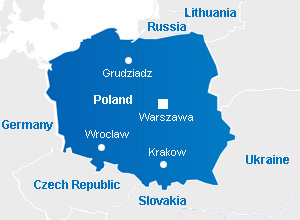
The 5th largest country in the EU by population
A nation with a proud cultural heritage
Key player in EU policies related to Eastern Europe, especially Ukraine and Russia
Large and diversified market
Total area: 311,895 sq km
Population: 37.5 million
Government type: Parliamentary democracy
Administrative division: 16 administrative regions (“voivodships”)
Capital + other major cities: Warsaw (1.8 million), Lodz (768,000), Krakow (755,000),
Currency: zloty (PLN)
Languages: Polish (official) 98.2%
Ethnicity: Polish 96.9%, Silesian 1.1%, German 0.2%, Ukrainian 0.1%, other & unspecified 1.7%
Religion: Roman Catholic 71.3%, Eastern Orthodox 0.4%, Protestant 0.4%, Jehovah’s Witnesses: 0.3%, no religion: 6.9%, undeclared 20.5% (2021 census)
President: (Mr.) Karol NAWROCKI (since August 6, 2025)
Prime Minister: (Mr.) Donald TUSK (since December 13, 2023)
Date of EU accession: 1 May 2004
KEY FEATURES
- Largest consumer market by value in CEE
- 6th largest economy in the EU
- Stable and steadily growing economy
- 2nd highest R&D expenditure in CEE
- Strategic location for manufacturing and logistics companies
- Rapidly expanding transport and infrastructure networks
- NATO leader in defense spending, allocating 5% of GDP to defense
- Regional disparities between western and eastern regions
- EU’s third largest wheat, rapeseed, and corn producer
MACROECONOMIC OVERVIEW
Poland stands out as one of the most successful and open transition economies in the CEE region. Privatization of small and medium-size firms in the early 1990s and liberal law on establishing new firms led to rapid development of a private sector.
Poland enjoyed the longest period of uninterrupted GDP growth in Europe since 1990s spanning 30 years. Its GDP kept growing even during the financial crisis in 2008 when the rest of the EU economy was contracting. And the GDP decline triggered by Covid-19 in 2020 was one of the shallowest in the EU.
After a sharp slowdown in 2023, Poland’s economy rebounded in 2024 with growth of around 2.9 % supported by stronger domestic demand, private consumption, and EU‑funded investment. In 2025, growth is expected to remain robust at 3.2%. The country’s high competitiveness, market resilience, economic diversification, and good fiscal policy should ensure growth in the forthcoming years. The unemployment rate is relatively low compared with the EU average.
Despite its strong economic performance, Poland is dealing with fiscal challenges, as government deficits have repeatedly exceeded 6% over the past three years. The country also faces demographic pressures, as it has one of the lowest fertility rates in the EU.
Selected economic indicators, Poland, 2018 - 2024
| 2018 | 2019 | 2020 | 2021 | 2022 | 2023 | 2024 | ||
| GDP |
|
|
|
|
|
|
|
|
| Real GDP growth |
%
|
5.9 | 4.5 | -2.0 | 6.9 | 5.3 | 0.2 | 3.0 |
| GDP at current prices |
€ bn
|
496.36 | 532.5 | 526.44 | 576.38 | 656.9 | 750.8 | 845.6 |
| Foreign trade |
|
|||||||
| Exports |
€ bn
|
275.93 | 295.59 | 294.18 | 348.93 | 412.58 | 434.06 | 442.5 |
| Imports |
€ bn
|
258.87 | 270.21 | 258.64 | 322.82 | 400.93 | 388.34 | 408.6 |
| Balance |
€ bn
|
17.06 | 25.38 | 35.54 | 26.1 | 11.64 | 45.72 | 33.9 |
| Prices |
|
|||||||
| CPI – average inflation rate |
%
|
1.6 | 2.3 | 3.4 | 5.1 | 14.4 | 11.4 | 3.7 |
| PPI – industry – average |
%
|
2.9 | 1.6 | -0.9 | 9.9 | 28.9 | 4.0 | -6.6 |
| Employment |
|
|||||||
| Registered unemployment |
%
|
3.9 | 3.3 | 3.2 | 3.4 | 2.9 | 2.8 | 2.9 |
| Average monthly gross wage |
€
|
1,076 | 1,220 | 1,175 | 1,240 | 1,426 | 1,633 | 1,864 |
| Exchange rates* |
|
|
|
|
|
|
|
|
| USD/PLN average (PLN per USD) |
|
3.613 | 3.839 | 3.9 | 3.862 | 4.458 | 4.197 | 3.981 |
| EUR/PLN average |
|
4.262 | 4.298 | 4.443 | 4.565 | 4.686 | 4.541 | 4.307 |
Source: IMF, Statistics Poland, OECD, Eurostat, 2018-2025
* For the current exchange rate, please see www.xe.com
KEY SECTORS
The structure of the Polish economy has undergone significant transformation over the past three decades. At the same time, the emergence of modern industrial sectors was largely enabled by strong inflows of foreign direct investment.
Today, Poland’s leading industries include food and beverage processing, automotive, chemicals and pharmaceuticals, electronics, ICT, mechanical engineering, and furniture manufacturing. Services account for approximately 60% of GDP, while industry represents around 32%. Agriculture employs about 8% of the workforce and contributes 2.75% of GDP.
Agriculture & Food processing
Poland is a significant European producer of a diverse range of agricultural products. The country is the EU’s largest producer of poultry and apples, the second-largest grower of potatoes (after Germany), and ranks third in sugar beets, rapeseed, and pork. Based on strong agriculture, the highly competitive food & beverage sector accounts for 20% of Poland’s manufacturing output. For fast-moving consumer goods producers, Poland is the manufacturing hub for the wider EU and even EMEA (Europe, Middle East, and Africa) markets. Poland's agricultural sector is currently undergoing a massive technological pivot with new investments into automation and precision agriculture.
Chemicals
Poland is the largest chemical exporter in Central and Eastern Europe (CEE) and is home to one of the region’s largest chemical industries. Key segments include petrochemicals, plastics, fertilizers, and construction-related chemicals, with approximately 70% of the industry’s revenue generated by supplying other industrial sectors. The chemical industry accounts for 18% of total industrial output and employs around 341,000 people. The pharmaceutical sector is strengthening its position, leading the CEE in R&D investment. Poland also holds a regional leadership position in cosmetics, detergents, and household chemicals.
Advanced manufacturing
The manufacturing industry remains a cornerstone of the Polish economy, contributing approximately 20% to 25% of the national GDP and employing around 2.8 million people. Within this sector, the automotive industry serves as a primary pillar by accounting for roughly 8% of the GDP and generating 13% of all Polish exports. Electromobility has become a central driver of innovation, anchored by one of the world’s largest electric vehicle battery production plants operated by LG Energy Solution.
Southern Poland’s Aviation Valley, the nation’s premier aerospace cluster, includes 194 companies employing over 35,000 people and generating roughly 90% of Poland’s aerospace output. Fully integrated into global supply chains, its companies produce components found in nearly every passenger aircraft worldwide.
Defense & military
Poland leads NATO in defense spending relative to GDP, projected at 4.8% in 2025. Since the Russian invasion of Ukraine, it has launched its most ambitious military modernization program, with a focus on expanding domestic defense production and reducing reliance on foreign imports. The defense industry is consolidated under PGZ – Polska Grupa Zbrojeniowa S.A., the country’s largest defense holding.
Environmental Technologies
Poland has established itself as a key EU manufacturing hub for environmental technologies, supported by substantial investment inflows, rapid growth in renewable energy capacity, and an expanding footprint in clean-technology production. The country accounts for around 60% of Europe’s lithium-ion battery output and is the world’s second-largest battery exporter, behind China. As of 2023, Poland’s renewable energy sector employed approximately 194,000 people. The environmental technology manufacturing base encompasses renewable energy equipment, heat pumps, advanced battery systems, waste-management machinery, or water-treatment solutions.
ICT
Poland’s main technological strengths include IoT, blockchain, an active start-up community with several internationally successful companies such as Booksy, Brainly, DocPlanner, and ElevenLabs. The IT industry accounts for approximately 8% of Poland’s GDP. The country hosts more than 2,000 shared service centers (70% of all centers located in CEE), which employ nearly 500,000 people. While these centers were initially focused on back-office tasks, they have now shifted toward Knowledge-Intensive Business Services, with over 54% of centers handling complex mid-office functions like advanced analytics and cybersecurity.
Poland has also become a major cloud hub in Central and Eastern Europe. Google launched its cloud data hub in Warsaw in 2021, followed by Microsoft Azure in 2023. The country is making significant investments in emerging technologies, including quantum computing and artificial intelligence, supported by the recently established AI Fund.
In addition, the video game industry stands out as one of Poland’s most competitive sectors, employing more than 15,200 people.
EXPORTS & IMPORTS
Poland is relatively less open to international trade due to its large domestic market, which helps limit exposure to external shocks. The EU accounts for 74% of Poland’s exports, while 67.4% of its imports originate from the EU, underscoring the country’s strong integration within the EU market.
2024 export and import data:
Main import partners:
Germany – 19.2%
China – 14.5%
USA – 5%
Italy – 4.7%
Netherlands – 3.9%
Main export partners:
Germany – 27.1%
Czechia – 6.1%
France – 6.1%
United Kingdom – 5.3%
Netherlands – 4.6%
Market Research in Poland
EasyLink provides professional expertise in strategic market research, market intelligence, competitive intelligence, market size analysis and market potential evaluation, competitive landscape and distribution structure study, identification of new customers and potential partners etc. Please contact us to discuss how we can assist your business objectives in export, marketing or sourcing.
Customer Search & Partner Search in Poland
We are experienced experts in matchmaking projects involving the search, identification, screening and pre-selection of business partners in Central & Eastern Europe, ranging from distributor search to profiling of prospective customers and identifying specific business opportunities; we assist our clients with sourcing in emerging markets and low-cost markets in the CEE region.
International Trade Consultancy – Export, Marketing and Trade Promotion in Poland and the CEE region
EasyLink has a unique track record in international trade promotion. With local consultants in all key markets in Central & Eastern Europe, EU markets and some overseas markets, we provide customized market research, develop trade opportunities with prospective partners and new customers, and assist clients with strategic advice for their export, marketing and sourcing needs.