Švédsko
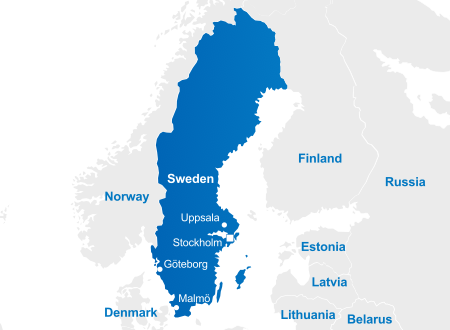
The 3rd largest country in the EU. Sweden enriched the world with IKEA, Volvo, Spotify or ABBA.
Total area: 450,295 sq km (roughly the size of California)
Population: 10.5 million
Government type: Constitutional monarchy with a parliamentary system
Administrative division: 21 counties (called “län”)
Capital + other major cities: Stockholm (989,000) + Göteborg (604,000), Malmö (362,000), Uppsala (245,000)
Currency: Swedish krona (SEK)
Language: Swedish (official) + 5 official minority languages: Sami, Finnish, Meänkieli (Tornedalen Finnish), Yiddish and Romani Chib
Ethnicity: Swedish 79.6%, Syrian 1.9%, Iraqi 1.4%, Finnish 1.3%, other 15.8% (2022 est.)
Religion: Lutheran (54%), other (9%), none or unspecified (37%)
King: Carl XVI Gustaf
Prime Minister: (Mr.) Ulf KRISTERSSON (since 2022)
Date of EU accession: 1995
KEY FEATURES
- Joined NATO in 2024 following Russia’s invasion of Ukraine (Sweden did not take part in any war for 200 years)
- About the same size as California
- One of the most forested countries in Europe
- The sixth least corrupt country in the world
- Most of the population live in the south
- A welfare state with high gender equality
- R&D expenditures are the second-highest in the EU (3.4% of GDP)
- Leader in new ICT technologies
- Holds an AAA credit rating
- Wants to achieve carbon neutrality by 2045
MACROECONOMIC OVERVIEW
Sweden has a robust and well-diversified economy characterized by high competitiveness and productivity. Innovation and new technologies, together with manufacturing, form the backbone of Swedish industry. Macroeconomic stability has been strengthened by legislative measures adopted in the past. In 1996, Sweden introduced a ceiling on public spending, followed by the introduction of a debt anchor (skuldankare) in 2019, which aims to keep long-term public debt below 35% of GDP.
Despite the challenges posed by the COVID-19 pandemic, Sweden’s economy proved relatively resilient. However, the Russian invasion of Ukraine negatively affected economic growth and contributed to inflation reaching a 30-year high. This occurred despite Sweden’s relatively low dependence on fossil fuel imports, as approximately 69% of its energy consumption comes from renewable sources, mainly hydropower, wind, biofuels, and heat pumps.
After a mild recession in 2023 and near-zero growth in 2024, the economy is now gaining momentum. GDP growth is projected to reach 2.9% in 2026, driven primarily by a recovery in private consumption. Inflation has eased and returned to pre-pandemic levels and is expected to fall to 0.6% in 2026, partly due to a planned temporary reduction in VAT on food, effective from April 2026 through 2028.
Selected economic indicators, Sweden, 2018 - 2024
| 2018 | 2019 | 2020 | 2021 | 2022 | 2023 | 2024 | ||
| GDP |
|
|
|
|
|
|
|
|
| Real GDP growth |
%
|
1.9 | 2.5 | -2.0 | 5.9 | 1.3 | -0.2 | 0.9 |
| GDP at current prices |
€ bn
|
467.1 | 475.3 | 478.8 | 538.6 | 551.7 | 540.6 | 558.0 |
| Foreign trade |
|
|
|
|
|
|
|
|
| Exports |
€ bn
|
214.3 | 229.3 | 211.9 | 254.7 | 297.3 | 298.3 | 303 |
| Imports |
€ bn
|
206.6 | 210.4 | 191.8 | 231.4 | 286.7 | 276.7 | 287.8 |
| Balance |
€ bn
|
7.7 | 18.9 | 20.1 | 23.3 | 10.6 | 21.6 | 15.2 |
| Prices |
|
|
|
|
|
|
|
|
| CPI – average inflation rate |
%
|
2.0 | 1.7 | 0.7 | 2.7 | 8.1 | 5.9 | 2 |
| PPI – industry – average |
%
|
5.5 | 2.7 | -2.3 | 11.0 | 20.3 | -3.2 | 0.1 |
| Employment |
|
|
|
|
|
|
|
|
| Registered unemployment |
%
|
6.5 | 7.0 | 8.5 | 8.9 | 7.5 | 7.7 | 8.4 |
| Average monthly gross wage |
€
|
3,392 | 3,362 | 3,471 | 3,673 | 3,613 | 3,791 | 3,933 |
| Exchange rates* |
|
|
|
|
|
|
|
|
| USD/SEK average (SEK per USD) |
|
8.7 | 9.4 | 9.2 | 8.5 | 10.1 | 10.6 | 10.6 |
| EUR/SEK average |
|
10.2 | 10.5 | 10.4 | 10.1 | 10.6 | 11.4 | 11.4 |
Source: Statistics Sweden, IMF, OECD, World Bank, Eurostat, ECB, 2018-2025
* For the current exchange rate, please see www.xe.com
KEY SECTORS
Sweden has a strong and technologically advanced industrial sector. Manufacturing contributes approximately 18–20% of Sweden’s GDP, with key industries including automotive manufacturing, machinery, pharmaceuticals, steel, and advanced engineering. In recent years, new ICT and digital technologies have gained increasing importance and have become a significant driver of productivity, innovation, and exports within the Swedish economy.
Mining plays a strategic role in Sweden’s industrial base. The country holds some of the largest iron ore reserves in Europe, with the Kiruna and Malmberget mines accounting for more than 80% of the EU’s iron ore production. Iron ore remains a crucial export commodity for Sweden.
The services sector dominates the Swedish economy, contributing roughly two-thirds of GDP and employing the majority of the workforce. Key service industries include finance, information technology, telecommunications, logistics, retail, and business services, reflecting Sweden’s high level of digitalization.
Agriculture contributes a relatively small share to national GDP, at approximately 1.4%. Only about 8% of Sweden’s land area is used for agricultural purposes, mainly concentrated in the southern regions. Agricultural production focuses primarily on cereals, dairy, and meat, alongside forestry-related activities, with a strong emphasis on sustainability and environmental standards
Automotive Industry
The automotive industry is a vital part of the Swedish economy, with major companies such as Volvo and Scania playing key roles in truck, bus, and passenger car production. The luxury car manufacturer Koenigsegg is also a well-known part of the industry. The Swedish automotive sector accounts for more than 13% of manufacturing employment and directly employs over 80,000 people. Sweden remains a major player in Europe’s bus market, led by Scania and Volvo Buses.
Manufacturing
Sweden is renowned for its manufacturing industries, particularly in engineering, electronics, and metal products. The sector contributes approximately 20% of GDP, with industrial technologies and advanced engineering forming its backbone. Many Swedish companies, including ABB, Atlas Copco, and Ericsson, have gained strong global reputations.
The manufacturing sector employs around 13% of the total workforce and ranks second in Europe in terms of robot density, reflecting its high level of automation and technological sophistication.
ICT and Technology
Sweden is a global leader in telecommunications and technology, with a strong focus on innovation, digital services, and ICT development. The ICT sector accounts for approximately 9% of GDP and is a major driver of economic growth and exports. Stockholm has emerged as the Nordic hub for start-ups, hosting a significant number of “unicorns,” second only to Silicon Valley in terms of tech scale-ups per capita.
The country is also a major player in the gaming industry, which generates annual revenues of around EUR 3.3 billion.
Life Sciences
Sweden has a well-established pharmaceutical and biotechnology sector, with around 4,000 companies focused on life sciences, primarily concentrated in the Stockholm and Uppsala regions. The sector employs approximately 56,000 people, and pharmaceuticals alone account for about 7% of Sweden’s total merchandise exports.
The country is a frontrunner in Advanced Therapy Medicinal Product (ATMP) research and development. Key players include the global pharmaceutical leader AstraZeneca, alongside a thriving network of biotech start-ups and research institutions that continue to drive innovation in the life sciences.
Forestry and Paper Products
Given Sweden’s extensive forest resources, which cover 69% of the country’s land area, the forestry and paper industry remains strategically important. Sweden is one of the largest timber producers in Europe, and its furniture industry is globally recognized, with IKEA serving as a prominent example. The country is also the largest sawnwood exporter in Europe.
The forest industry contributes 9–12% of Swedish industry’s total employment, exports, turnover, and value creation. It directly employs approximately 140,000 people and continues to play a key role in Sweden’s economy, combining sustainable forest management with high-value production in paper, wood products, and furniture.
Defense industry
Sweden has a well-established defense industry, one of the largest and most technologically advanced in Europe. The sector is known for its high level of innovation, with a strong focus on aerospace, naval systems, and land defense, and it employs more than 35,000 people.
The country is largely self-sufficient in many areas, including production, raw materials, and design, and consistently ranks among the top 15 global arms exporters. Key companies include Saab AB, renowned for its Gripen fighter jets, submarines, radars, and electronic warfare systems, and BAE Systems AB, known for the Combat Vehicle 90.
Sweden is currently undertaking its most extensive rearmament since the Cold War, with a 2026 focus on short-range air defense systems and autonomous electronic warfare capabilities.
EXPORTS & IMPORTS
Sweden is an export-oriented country, with a GDP-to-export ratio of 55%. Its closest trade partners are Germany and neighboring Norway. Since late 2024, the United States has become Sweden’s third-largest trading partner, driven by strong demand for Swedish defense equipment and pharmaceuticals.
2024 export and import data:
Main import partners:
Germany – 16.2%
Netherlands – 10.9%
Norway – 9.4%
Denmark – 6.6%
China – 6.3%
Main export partners:
Germany – 10%
Norway – 9.6%
USA – 8.7%
Denmark – 6.8%
Finland – 6.7%
Market Research in Sweden
EasyLink provides professional expertise in strategic market research, market intelligence, competitive intelligence, market size analysis and market potential evaluation, competitive landscape and distribution structure study, identification of new customers and potential partners etc. Please contact us to discuss how we can assist your business objectives in export, marketing or sourcing.
Customer Search & Partner Search in Sweden
We are experienced experts in matchmaking projects involving the search, identification, screening and pre-selection of business partners in Europe, ranging from distributor search to profiling of prospective customers and identifying specific business opportunities; we assist our clients with sourcing in emerging markets and low-cost markets in the region.
International Trade Consultancy – Export, Marketing and Trade Promotion in Sweden and Scandinavia
EasyLink has a unique track record in international trade promotion. With local consultants in all key markets in Central & Eastern Europe, EU markets and some overseas markets, we provide customized market research, develop trade opportunities with prospective partners and new customers, and assist clients with strategic advice for their export, marketing and sourcing needs.