Norsko
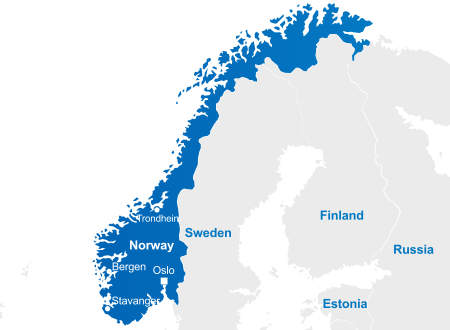
Stunning fjords, breathtaking mountains and spectacular wildlife combined with a high quality of life
Total area: 323,802 sq km (roughly the size of Montana)
Population: 5.5 million
Government type: Constitutional monarchy with a parliamentary system
Administrative division: 19 counties (called “fylker”)
Capital + other major cities: Oslo (580,000) + Bergen (214,000), Trondheim (147,000), Stavanger (122,000)
Currency: Norwegian kroner (NOK)
Languages: Norwegian (Bokmål and Nynorsk), Sami
Ethnicity: Norwegian (81.5%), other European (8.9%), other 9.6% (2021 est.)
Religion: Evangelical Lutheran (67.5%), Muslim (3.1%), Roman Catholic 3.1%, other Christian 3.8%, other 2.6%, unspecified 19.9%
King: Harald V.
Prime Minister: (Mr.) Jonas Gahr STØRE (since 2021)
Date of EU accession: Not an EU Member
KEY FEATURES
- Not a member of the EU
- Has economic ties with the EU through the European Economic Area (EEA)
- Founding member of NATO
- The largest European oil & gas producer
- Ranks first in the World Press Freedom
- Among the top 10 countries worldwide in GDP per capita
- One of the world’s largest exporters of seafood
- Hydropower generates almost 90% of Norway’s annual electricity production
MACROECONOMIC OVERVIEW
Norway is an open, high-income economy with one of the world’s highest standards of living, supported by abundant natural resources, strong institutions, and prudent economic management. Since the discovery of North Sea oil and gas in the 1970s, the country has become one of Europe’s largest oil and gas producers and established a substantial sovereign wealth fund that underpins long-term fiscal stability.
Economic growth has been moderate but resilient. After a mild slowdown during the COVID-19 pandemic, Norway’s GDP expanded by around 2.1% in 2024, supported by strong energy production and robust domestic demand. Growth is expected to remain steady, with forecasts indicating real GDP growth of about 1.7% in 2026 and 1.5% in 2027, driven by private consumption, investment, and a gradual recovery in non-oil sectors.
Inflation was slightly elevated in recent years due to global price pressures but has been trending downward after peaking at 5.8% in 2022. The labor market remains relatively strong, with the unemployment rate standing at 4.0%. Norway’s strong public finances, large sovereign wealth fund, and current account surpluses provide buffers against economic volatility. However, structural risks such as strong dependence on oil and gas production, skill mismatches, and unfavorable demographic trends remain key considerations for policymakers.
Selected economic indicators, Norway, 2018 - 2024
| 2018 | 2019 | 2020 | 2021 | 2022 | 2023 | 2024 | ||
| GDP |
|
|
|
|
|
|
|
|
| Real GDP growth |
%
|
0.8 | 1.1 | -1.3 | 3.9 | 3.2 | 0.1 | 2.1 |
| GDP at current prices |
€ bn
|
372.6 | 365.1 | 322.8 | 425.4 | 565.0 | 448.7 | 446.86 |
| Foreign trade |
|
|
|
|
|
|
|
|
| Exports |
€ bn
|
142.4 | 133.7 | 103.9 | 183.0 | 313.3 | 211.7 | 212.2 |
| Imports |
€ bn
|
118.4 | 125.0 | 106.9 | 119.9 | 153.3 | 145.6 | 151.3 |
| Balance |
€ bn
|
24 | 8.7 | -3 | 63.1 | 160 | 66.1 | 60.9 |
| Prices |
|
|
|
|
|
|
|
|
| CPI – average inflation rate |
%
|
2.8 | 2.2 | 1.3 | 3.5 | 5.8 | 5.5 | 3.1 |
| PPI – industry – average |
%
|
8.6 | 3.2 | -2.1 | 12.5 | 25.9 | 6.5 | 2.0 |
| Employment |
|
|||||||
| Registered unemployment |
%
|
4.0 | 3.9 | 4.7 | 4.4 | 3.2 | 3.6 | 4.0 |
| Average monthly gross wage |
€
|
4,793 | 4,869 | 4,556 | 5,029 | 5,262 | 4,944 | 5,104 |
| Exchange rates* |
|
|
|
|
|
|
|
|
| USD/NOK average (NOK per USD) |
|
8.1 | 8.8 | 9.4 | 8.5 | 9.6 | 10.5 | 10.75 |
| EUR/NOK |
|
9.6 | 9.8 | 10.7 | 10.1 | 10.1 | 11.4 | 11.63 |
Source: IMF, OECD, World Bank, Eurostat, ECB, 2018-2025
* For the current exchange rate, please see www.xe.com
KEY SECTORS
While industry generates significant value in terms of GDP (37%), it employs only about 19% of the workforce. This is largely due to the oil and gas sector, which alone contributes an impressive 22% of Norway’s GDP. The majority of Norwegians (78%) work in the service sector, which represents approximately 52% of total output. Agriculture and fishing together contribute around 2.5% of GDP.
Norway’s largest source of national income comes from the extraction and export of offshore oil and gas. Other significant industries include fishing, steel, shipping, and tourism. The ocean-based industries generate around 40% of the country’s GDP and employ approximately 225,000 Norwegians. Although smaller compared to other sectors, manufacturing is diverse, ranging from advanced machinery and equipment to chemicals and processed metals. Key manufacturing sectors include aluminum production, chemicals, and industrial machinery.
Oil and Gas Industry
Norway is one of the world’s leading producers and exporters of oil and natural gas and currently serves as Europe’s largest gas supplier. Equinor is the largest energy operator in this sector. Exports of crude oil, natural gas, and refined petroleum products account for nearly 65% of the country’s total export value. Since 1990, revenues from these exports have been directed into the Government Pension Fund Global (GPFG), commonly known as the Norwegian Oil Fund, which is designed to ensure that the income benefits both current and future generations. The fund is the largest sovereign wealth fund in the world.
Maritime Industry
Norway excels globally in shipping, shipbuilding, and maritime technology, ranking as the world’s fifth-largest shipping nation by fleet value, after China, Greece, Japan, and the United States. LNG and LPG vessels remain a critical segment of the fleet, collectively accounting for nearly 25% of total fleet value. The maritime industry is a vital pillar of the national economy, serving as the second-largest export sector and employing around 90,000 people. Norway remains at the forefront of maritime innovation, particularly in green technologies and automation, through the development of hybrid and fully electric vessels as well as autonomous ship technologies. Major shipyards include VARD Group, Ulstein Group, and Green Yard Kleven.
Aquaculture
Leveraging its extensive coastline, Norway holds a significant position in the seafood industry, particularly in salmon farming. In 2025, Norwegian exports of farmed salmon reached an all-time high of 2.8 million tons, reinforcing its global leadership in the sector. The salmon farming industry is primarily composed of small and medium-sized businesses, each operating an average of 6–10 sea cages. Approximately 95% of production is exported.
Renewables and Cleantech
Norway is a pioneer in renewable energy, particularly hydroelectric power, which accounts for 89% of the country’s electricity generation, while wind power contributes an additional 11%. The country sets ambitious environmental goals and invests in renewable energy projects, energy-efficient technologies, and sustainable infrastructure. For example, Norway is investing in Carbon Capture and Storage (CCS) technologies to mitigate greenhouse gas emissions.
ICT
Norway’s technology sector is growing, with a focus on digitalization, software development, cybersecurity, data centers, and IT services. The ICT sector contributes approximately 4.6% to Norway’s GDP. Key technology hubs are located in major cities such as Oslo, Bergen, and Trondheim.
EXPORTS & IMPORTS
Beyond its petroleum exports, Norway is the world’s second-largest seafood exporter and a key supplier of green aluminum and advanced maritime technology. Its main export partners include the UK and Germany, supported by pipeline infrastructure and geographic proximity. Conversely, Norway relies on imports from China and the EU for vehicles, electronics, and consumer goods.
2024 export and import data:
Main import partners:
China – 11.9%
Sweden – 10.4%
Germany – 10.4%
USA – 7.6%
United Kingdom – 4.6%
Main export partners:
United Kingdom – 19%
Germany – 15.6%
Netherlands – 10.6%
Sweden – 6.9%
France – 6.1%
Market Research in Norway
EasyLink provides professional expertise in strategic market research, market intelligence, competitive intelligence, market size analysis and market potential evaluation, competitive landscape and distribution structure study, identification of new customers and potential partners etc. Please contact us to discuss how we can assist your business objectives in export, marketing or sourcing.
Customer Search & Partner Search in Norway
We are experienced experts in matchmaking projects involving the search, identification, screening and pre-selection of business partners in Europe, ranging from distributor search to profiling of prospective customers and identifying specific business opportunities
International Trade Consultancy – Export, Marketing and Trade Promotion in Norway and Scandinavia
EasyLink has a unique track record in international trade promotion. With local consultants in all key markets in Central & Eastern Europe, EU markets and some overseas markets, we provide customized market research, develop trade opportunities with prospective partners and new customers, and assist clients with strategic advice for their export, marketing and sourcing needs.