Hungary
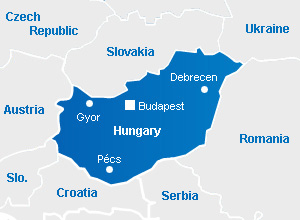
A landlocked country with a large number of spa towns and hot springs
Home to Lake Balaton, the largest lake in Central Europe, Rubik’s cube and ballpoint pen.
An emerging strong EV hub thanks to the Chinese FDI
Total area: 93,028 sq km (smaller than Indiana)
Population: 9.6 million
Government type: Parliamentary democracy
Administrative division: 19 counties (called “varmegye”), 23 urban counties (called “megyei jogú város”), and 1 capital city (called “fovaros”)
Capital + other major cities: Budapest (1.7 million) + (Debrecen (199,000), Szeged (158,000), Miskolc (145,000), Pecs (139,000), Gyor (128,000)
Currency: forint (HUF)
Languages: Hungarian (official) 99.6%, other or unspecified 0.4%
Ethnicity: Hungarian 85.6%, Roma 3.2%, Germans 1.9%, undeclared 16.7%
Religion: Roman Catholic 37%, Calvinist 11%, Lutheran 2.2%, Greek Catholic 1.8%, other 0.5%, atheist 1.5%, unaffiliated 16.7%, undeclared 27.2%
President: (Mr.) Tamás SULYOK (since 26 February 2024)
Prime Minister: (Mr.) Viktor ORBAN (since 29 May 2010)
Date of EU accession: 1 May 2004
KEY FEATURES
- Central location positioning the country as an ideal gateway to Central/Southeastern Europe
- Bordering seven other European countries
- Highly skilled and educated workforce
- One of the least regulated economies in the CEE region
- One of the most sought-after FDI destinations in Europe
- Strong automotive, electronics, and service sectors
- One of the most developed biotechnology sectors in Central and Eastern Europe
- The lowest corporate tax in the EU (9%)
- A leading destination for Asian FDI in Europe (one-third of Chinese investment into the EU and the UK)
MACROECONOMIC OVERVIEW
Hungary, similar in size and population to the Czech Republic, remains one of Central and Eastern Europe’s most tax-attractive and industrially developed economies. The country has excellent infrastructure, including ready-made industrial sites, offices, and science parks.
Hungary experienced a 0.9% contraction in 2023, followed by modest economic growth of 0.5% in 2024, reflecting weak industrial performance, reduced public spending, and sluggish exports linked to Germany’s industrial slowdown. Growth was mainly supported by resilient household consumption driven by strong wage increases.
According to the European Commission, GDP is expected to grow by 0.4% in 2025 and accelerate to roughly 2.3% in 2026, supported by private consumption and a gradual recovery in investment and exports. Inflation, which averaged 17.2% in 2023, fell sharply to 3.7% in 2024 and is projected to remain moderate in the coming years. Hungary’s labor market remains robust, with unemployment at 4.5%, among the lowest in the EU.
Hungary faces persisting problems regarding EU funds as the country permanently lost EUR 1.04 billion in cohesion funds in 2024 due to non-compliance with rule of law conditions, and additional funds remain at risk. All this has a negative impact on Hungary’s fiscal situation. With EU funding partially frozen, the government has turned to China as an alternative economic partner, attracting significant Chinese direct investment, particularly in the battery sector, and positioning Hungary as a key gateway for Chinese companies into the EU.
Selected economic indicators, Hungary, 2018 - 2024
| 2018 | 2019 | 2020 | 2021 | 2022 | 2023 | 2024 | ||
| GDP |
|
|
|
|
|
|
|
|
| Real GDP growth |
%
|
5.4 | 4.9 | -4.5 | 7.1 | 4.2 | -0.8 | 0.6 (p) |
| GDP at current prices |
€ bn
|
136.07 | 146.11 | 137.44 | 154.12 | 168.5 | 196.3 | 206.2 |
| Foreign trade |
|
|||||||
| Exports |
€ bn
|
113.63 | 119.48 | 108.59 | 125.35 | 153.86 | 159.47 | 153.9 |
| Imports |
€ bn
|
107.78 | 116.1 | 105.73 | 124.18 | 160.83 | 149.43 | 142.5 |
| Balance |
€ bn
|
5.85 | 3.38 | 2.85 | 1.17 | -6.96 | 10.03 | 11.4 |
| Prices |
|
|||||||
| CPI – average inflation rate |
%
|
2.8 | 3.4 | 3.3 | 5.1 | 14.5 | 17.1 | 3.7 |
| PPI – industry – average |
%
|
6.1 | 3.9 | 0.8 | 16.9 | 53.1 | 21.5 | -1.8 |
| Employment |
|
|||||||
| Registered unemployment |
%
|
3.6 | 3.3 | 4.1 | 4.1 | 3.6 | 4.1 | 4.5 |
| Average monthly gross wage |
€
|
1,220 | 1,280 | 1,195 | 1,278 | 1,372 | 1,609 | 1,764 |
| Exchange rates* |
|
|||||||
| USD/HUF average (HUF per USD) |
|
270.41 | 290.71 | 307.99 | 303.14 | 372.59 | 352.91 | 365.58 |
| EUR/HUF |
|
318.89 | 325.35 | 351.25 | 358.52 | 391.29 | 381.8 | 395.46 |
Source: Hungarian Central Statistical Office, Hungarian National Bank, IMF, Eurostat, 2018-2025
* For the current exchange rate, please see www.xe.com
KEY SECTORS
The agricultural sector, historically a major component of Hungary’s economy, now accounts for nearly 4% of GDP and employs approximately 4.4% of the workforce. Key crops include cereals, fruits, vegetables, and wine.
Industry contributes 24% of GDP and employs around 31% of the workforce. It is highly open to foreign investment, with manufacturing consistently ranking among the top recipients of FDI. The automotive and electronics sectors, now strengthened by a growing electric vehicle battery industry, are the main industrial drivers, together accounting for over half of all exports.
The services sector is the largest segment of the economy, contributing 60% of GDP and employing nearly 64% of the labor force.
Automotive sector
The automotive sector is the backbone of Hungarian industry and a key engine of economic growth. Most automotive production is export-oriented, accounting for approximately 21% of Hungary’s total exports. Hungary currently manufactures approximately 450,000 passenger cars annually, ranking fourth in Central and Eastern Europe (CEE). However, production is projected to exceed 1 million passenger cars per year in the coming years. The automotive sector comprises around 700 companies and contributes about 20% of the national GDP.
The country hosts major global car manufacturers, including Audi (Volkswagen Group), Mercedes-Benz, Suzuki, and Stellantis (engine production for Opel), and is also becoming a key player in EU electric vehicle (EV) production. Chinese automaker BYD is building its first European plant in Szeged, while BMW is opening an innovative production facility in Debrecen for its electric iX3 model. Additionally, Hungary has successfully attracted major battery manufacturers (e.g., CATL), positioning the country as one of the world’s largest battery production hubs.
Electronics
The electronics sector is one of Hungary’s largest economic sectors, accounting for approximately 24.5% of total manufacturing output and employing around 163,000 people. Many of the world’s leading electronics manufacturing services (EMS) companies, such as Foxconn or Videoton, have established production facilities in Hungary. The country holds a leading role in the production of finished electronic products and is the largest electronics manufacturer in Central Europe.
ICT
The Hungarian ICT sector is a well-established and developed industry. The total ICT market accounts for approximately 7% of Hungary’s GDP and employs around 250,000 people. The sector is expected to continue growing, driven primarily by private-sector investment and demand.
Hungary offers a strong talent base with key ICT competencies in software development, cybersecurity, business intelligence, data science, and artificial intelligence (AI). The country also has a solid education pipeline, with approximately 26,000 IT students currently enrolled. Hungary’s startup ecosystem comprises more than 2,700 companies, with a notable number in Edtech startups.
Food and beverages
The Hungarian food and beverage industry plays a significant role in the national economy, with an estimated total value of nearly EUR 16.8 billion. It accounts for approximately 12.6% of total manufacturing output and employs more than 145,000 people. Hungary has a long tradition in the production of planting seeds and horticultural products and is a major agricultural and food exporter, ranking second globally in sweet corn exports and third within the EU in sunflower seed production.
Biotechnology
Hungary’s biotechnology and life sciences sector is highly competitive, supported by strong production capabilities and significant international investment from major global companies. As of 2025, over 100 biotech companies operate in the country, with pharmaceuticals representing the most innovation-intensive manufacturing sector, accounting for 24% of R&D expenditure. The broaden sector employs around 53,000 people and maintains extensive R&D partnerships with universities. Hungary is the largest exporter of medicinal and pharmaceutical products in CEE.
Key production strengths include tablets and capsules, biopharmaceuticals, sterile injectables, medical devices, and active pharmaceutical ingredients (APIs).
EXPORTS & IMPORTS
Hungary is one of the most open and trade-integrated economies in Europe, with an export-to-GDP ratio of approximately 76%. This high level of openness reflects its role as a strategic manufacturing hub within European supply chains. While Germany remains Hungary’s dominant trading partner, the country has significantly diversified its trade profile through substantial investments in the EV battery sector.
2024 export and import data:
Main import partners:
Germany – 23%
China – 6.4%
Poland – 6.3%
Austria – 6.1%
Slovakia – 6.1%
Main export partners:
Germany – 24.9%
Romania – 5.6%
Poland – 5.3%
Italy – 5.1%
Slovakia – 5%
Market Research in Hungary
EasyLink provides professional expertise in strategic market research, market intelligence, competitive intelligence, market size analysis and market potential evaluation, competitive landscape and distribution structure study, identification of new customers and potential partners etc. Please contact us to discuss how we can assist your business objectives in export, marketing or sourcing.
Customer Search & Partner Search in Hungary
We are experienced experts in matchmaking projects involving the search, identification, screening and pre-selection of business partners in Central & Eastern Europe, ranging from distributor search to profiling of prospective customers and identifying specific business opportunities; we assist our clients with sourcing in emerging markets and low-cost markets in the CEE region.
International Trade Consultancy – Export, Marketing and Trade Promotion in Hungary and the CEE region
EasyLink has a unique track record in international trade promotion. With local consultants in all key markets in Central & Eastern Europe, EU markets and some overseas markets, we provide customized market research, develop trade opportunities with prospective partners and new customers, and assist clients with strategic advice for their export, marketing and sourcing needs.