Slovenia
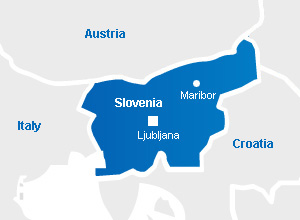
A small, well-developed, and highly specialized country with a strong biotech and pharmaceutical sector
Total area: 20,273 sq km (slightly smaller than New Jersey)
Population: 2.1 million
Government type: Parliamentary republic
Administrative division: 200 municipalities (called “obcina”) and 11 urban municipalities
Capital + other major cities: Ljubljana (275,000) + Maribor (95,000)
Currency: Euro (since 1 January 2007)
Languages: Slovene (in regions with Hungarian and Italian minorities, also Hungarian and Italian are official languages)
Ethnicity: Slovene 83.1%, Serb 2%, Croat 1.8%, Bosnian 1.1% and other or unspecified 12% (2002 census)
Religion: Catholic 57.8%, Muslim 2.4%, Orthodox 2.3%, other Christian 0.9%, unaffiliated 3.5%, other or unspecified 23%, none 10.1% (2002 census)
President: (Ms.) Natasa PIRC MUSAR (since 23 December 2022)
Prime Minister: (Mr.) Robert GOLOB (since 1 June 2022)
Date of EU accession: 1 May 2004
KEY FEATURES
- One of the most developed economies in Central and Eastern Europe
- Excellent, fully modernized communication and transportation infrastructure, including a major port Koper on the Adriatic Sea
- Highly educated workforce and a strong base of innovative technology firms
- Geostrategic position providing access to EU markets as well as Central and Southeast European markets
- Robot-intensive economy with a high level of automation
- Important R&D and manufacturing hub for the European pharmaceutical industry
MACROECONOMIC OVERVIEW
Slovenia is an advanced, independent, and stable economy, regularly achieving the highest nominal GDP per capita in Central and Eastern Europe. With a population of around two million, the country benefits from a strategic location at the crossroads of major European trade routes, serving as a gateway to both EU markets and the Western Balkans.
Since gaining independence in 1991, Slovenia has achieved significant gains in per capita and aggregate wealth, established a stable democracy, and raised living standards to levels comparable with Western Europe. Over the past decade, the country has maintained steady economic growth and macroeconomic stability, with GDP growth averaging around 2-3% per year prior to the COVID-19 pandemic. The economy has since rebounded and returned to stable growth.
After slow growth of approximately 1.0% in 2025, GDP is forecast to expand by around 2.4% in 2026, supported by rising external demand, large-scale government investments, and a recovery in domestic consumption. Inflation, which averaged about 2.5% in 2025, is expected to moderate slightly to roughly 2.3% in 2026 as food and energy prices stabilize. The labor market remains tight and competitive, with unemployment projected at approximately 3.5%.
Despite these strengths, Slovenia faces structural challenges, including one of the lowest levels of foreign direct investment per capita in the EU, labor productivity and competitiveness below the EU average, relatively high taxes, and a labor market perceived as inflexible.
Selected economic indicators, Slovenia, 2018 - 2024
| 2018 | 2019 | 2020 | 2021 | 2022 | 2023 | 2024 | ||
| GDP |
|
|
|
|
|
|
|
|
| Real GDP growth |
%
|
4.5 | 3.5 | -4.2 | 8.4 | 2.7 | 2.4 | 1.7 |
| GDP at current prices |
€ bn
|
45.75 | 48.01 | 47.02 | 52.2 | 57.0 | 63.0 | 67.4 |
| Foreign trade |
|
|
|
|
|
|
|
|
| Exports |
€ bn
|
38.79 | 40.54 | 36.54 | 43.45 | 53.69 | 52.99 | 54.55 |
| Imports |
€ bn
|
34.79 | 36.15 | 32.21 | 40.68 | 52.40 | 48.78 | 50.38 |
| Balance |
€ bn
|
4 | 4.39 | 4.32 | 2.76 | 1.29 | 4.21 | 4.17 |
| Prices |
|
|
|
|
|
|
|
|
| CPI – average inflation rate |
%
|
1.7 | 1.6 | -0.1 | 1.9 | 8.8 | 7.4 | 2.0 |
| PPI – industry – average |
%
|
2.1 | 0.7 | -0.2 | 5.5 | 22.8 | 8.6 | -2.2 |
| Employment |
|
|
|
|
|
|
|
|
| Registered unemployment |
%
|
5.1 | 4.5 | 5.0 | 4.8 | 4.0 | 3.7 | 3.7 |
| Average monthly gross wage |
€
|
– | 1,855 | 1,856 |
1,969
|
2,023
|
2,230
|
2,398
|
Source: Republic of Slovenia – Statistical Office, IMF, Eurostat, 2018-2025
KEY SECTORS
The agricultural sector in Slovenia is relatively small, contributing only about 1.5% of GDP, though it employs roughly 4% of the population. Agricultural land accounts for 36% of the country’s total area, with around 11% dedicated to organic production. Food and beverage production is largely based on small-scale farming. In contrast, forestry is a major economic sector, with forests covering 60% of Slovenia’s land and supporting timber and furniture production.
The industrial sector accounts for approximately 29% of GDP and 32% of employment. Key industries include mechanical sectors such as automotive, metal processing, and machinery, as well as high value-added industries like electronics, pharmaceuticals, and chemicals, all with a strong focus on R&D. Slovenia remains the third most industrialized country in the EU.
The services sector continues to be the most significant part of the Slovenian economy, representing 64% of GDP and employing 62% of the workforce. Over the past decade, it has shown strong growth, particularly in ICT sector, financial and commercial services, and retail. Tourism also remains a dynamic and growing component of the services sector.
Pharmaceuticals
The pharmaceutical industry has become Slovenia’s most profitable, R&D-intensive, and export-oriented sector, accounting for more than 41% of the country’s total goods exports. The sector is led by major companies such as Krka and Lek. The broader biotechnology industry contributes over 6% of GDP and directly and indirectly employs more than 50,000 people. In relative terms, measured by production per capita, Slovenia ranks among the 5 largest drug-manufacturing countries in Europe.
Slovenia’s pharmaceutical industry is closely integrated into global supply chains and maintains particularly strong trade ties with Switzerland, with more than 90% of Slovenia’s exports to Switzerland consisting of pharmaceutical products and organic chemicals.
Automotive
The automotive industry is a key pillar of Slovenia’s economy, accounting for around 20% of total exports and contributing approximately 10% of GDP. The sector employs around 17,600 people across 324 companies. It is characterized by a flexible network of highly specialized niche players with a strong focus on R&D, actively developing advanced systems and components ranging from power drives for electric and hybrid vehicles to exhaust systems.
Slovenia ranks as the seventh most robotized economy globally, with the automotive sector being the most automated branch. Revoz, fully owned by Renault Group, remains the country’s sole manufacturer of passenger cars.
Electrical & Electronics
The electrical and electronics industry has a long tradition in Slovenia and employs around 30,000 people, covering a wide range of high value-added manufacturing activities. A significant share of Slovenian electrical and electronics companies is focused on the automotive industry, supplying specialized components and systems.
The sector’s production spans home appliances, electric motors, transformers, power grid equipment, batteries, cables, and pumps. Slovenia is also a global leader in medical and industrial laser systems and advanced measurement devices, with companies such as Fotona recognized worldwide for their technological excellence.
ICT
Slovenia is a key player in the information and communications technology (ICT) sector, specializing in niche solutions for advanced telecommunications systems, cybersecurity, and Industry 4.0 applications. The sector employs approximately 29,000 people. The country is recognized as both a European and global leader in blockchain technology and is the world’s second nation, after China, to establish a national blockchain test infrastructure, known as SI-Chain. Slovenia has also secured EU funding to establish a national “AI Factory,” which includes a new high-performance supercomputer, designed to support AI-driven research.
EXPORT & IMPORT
Slovenia is highly open to international trade, with exports representing approximately 80% of GDP. The European Union remains the largest export market, accounting for 55% of Slovenian exports. In recent years, however, Switzerland has become Slovenia’s leading trading partner, surpassing traditional counterparts such as Germany. This shift is largely driven by pharmaceutical and chemical products transported between Slovenian production facilities and their Swiss headquarters, making Switzerland the leading country for both Slovenian exports and imports.
2024 export and import data:
Main import partners:
Switzerland – 24%
China – 12.2%
Germany – 9.5%
India – 8.8%
Italy – 7.8%
Main export partners:
Switzerland – 33.7%
Germany – 11.9%
Croatia – 7.7%
Italy – 7.1%
Austria – 4.4%
Market Research in Slovenia
EasyLink provides professional expertise in strategic market research, market intelligence, competitive intelligence, market size analysis and market potential evaluation, competitive landscape and distribution structure study, identification of new customers and potential partners etc. Please contact us to discuss how we can assist your business objectives in export, marketing or sourcing.
Customer Search & Partner Search in Slovenia
We are experienced experts in matchmaking projects involving the search, identification, screening and pre-selection of business partners in Central & Eastern Europe, ranging from distributor search to profiling of prospective customers and identifying specific business opportunities; we assist our clients with sourcing in emerging markets and low-cost markets in the CEE region.
International Trade Consultancy – Export, Marketing and Trade Promotion in Slovenia and the CEE region
EasyLink has a unique track record in international trade promotion. With local consultants in all key markets in Central & Eastern Europe, EU markets and some overseas markets, we provide customized market research, develop trade opportunities with prospective partners and new customers, and assist clients with strategic advice for their export, marketing and sourcing needs.