Slovakia
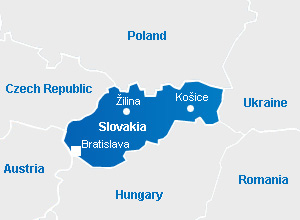
A small country in the heart of Europe with beautiful scenery, tourism and hospitable people, and the automotive industry as a key sector
Total area: 49,035 sq km
Population: 5.4 million
Government type: Parliamentary democracy
Administrative division: 8 regions (called “kraj”)
Capital + other major cities: Bratislava (437,000) + Kosice (238,000), Presov (88,000)
Currency: Euro (since January 2009)
Languages: Slovak 81.8% (official), Hungarian 8.5%, Roma 1.8%, other 2.2%
Ethnicity: Slovak 83.8%, Hungarian 7.8%, Roma 1.2%, other 1.8%, unspecified 5.4%
Religion: Roman Catholic 55.8%, Evangelical Church of the Augsburg Confession 5.3%, Greek Catholic 4%, Reformed Christian 1.6%, other 3%, none 23.8%
President: (Mr.) Peter PELLEGRINI (since 16 June 2024)
Prime Minister: (Mr.) Robert FICO (since 25 October 2023)
Date of EU accession: 1 May 2004
KEY FEATURES
- One of the most export‑oriented economies in the EU
- The world’s largest car producer per capita
- A leader in labor productivity in Central and Eastern Europe (CEE)
- Strategic location provides easy access to major EU markets.
- Second CEE country to adopt the euro (2009)
- Slovak language is mutually intelligible with Czech
MACROECONOMIC OVERVIEW
Slovakia is a high-income advanced economy with deep integration into European and global markets, where exports of goods and services remain the primary engine of GDP growth. Its economy is exceptionally reliant on the automotive sector, which accounts for more than half of industrial production.
After solid growth of 2.1% in 2024, economic momentum has slowed sharply. GDP is projected to expand by just 0.8% in 2025, with a modest recovery to around 1.0% expected in 2026. The slowdown reflects weak foreign demand, especially from Germany, trade tensions including U.S. tariffs on the automotive sector, and a significant domestic fiscal consolidation that has restrained consumption and investment.
Inflation has eased from the peaks of 2022–2023 but remains elevated at around 4.0%, driven by VAT hikes and the gradual removal of energy price caps. The labor market remains tight, with unemployment forecast at 5.4% in 2025.
Selected economic indicators, Slovakia, 2018 - 2024
| 2018 | 2019 | 2020 | 2021 | 2022 | 2023 | 2024 | ||
| GDP |
|
|
|
|
|
|
|
|
| Real GDP growth |
%
|
4.0 | 2.5 | -2.6 | 5.7 | 0.5 | 2.1 | 1.9 |
| GDP at current prices |
€ bn
|
89.72 | 94.18 | 93.44 | 100.32 | 109.65 | 122.8 | 130.98 |
| Foreign trade |
|
|
|
|
|
|
|
|
| Exports |
€ bn
|
86.21 | 86.77 | 78.67 | 91.16 | 108.62 | 112.28 | 111.62 |
| Imports |
€ bn
|
84.4 | 86.39 | 77.82 | 91.78 | 114.94 | 110.65 | 111.36 |
| Balance |
€ bn
|
1.82 | 0.37 | 0.85 | -0.62 | -6.32 | 1.63 | 0.26 |
| Prices |
|
|
|
|
|
|
|
|
| CPI – average inflation rate |
%
|
2.5 | 2.8 | 2.0 | 2.8 | 12.1 | 11.0 | 3.2 |
| PPI – industry – average |
%
|
5.0 | 2.6 | 0.8 | 5.5 | 44.0 | 16.9 | -19.7 |
| Employment |
|
|
|
|
|
|
|
|
| Registered unemployment |
%
|
6.5 | 5.7 | 6.7 | 6.8 | 6.1 | 5.8 | 5.3 |
| Average monthly gross wage |
€
|
1,013 | 1,219 | 1,133 | 1,211 | 1,304 | 1,430 | 1,524 |
Source: Eurostat, IMF, Statistical Office of the Slovak Republic, 2018-2025
KEY SECTORS
The agriculture sector in Slovakia accounts for only about 2% of GDP and 2.5% of employment, despite nearly two fifths of the country’s land being arable. Key agricultural products include cereals, potatoes, sugar beets, and grapes. The mountainous regions are covered with extensive forests and pastures, supporting intensive sheep grazing. Slovakia is also rich in critical raw materials and non-metallic minerals, such as magnesite, where it remains a leading global producer.
The secondary sector represents 28.5% of GDP and employs approximately 36% of the workforce. Building on a long-standing industrial tradition and a highly skilled labor force, Slovakia’s key industries include automotive, electronics, mechanical engineering, precision metalworking, chemicals, and ICT. High value-added industries, particularly electronics and engineering, are concentrated in the western regions of the country.
The services sector is the largest contributor to the Slovak economy, accounting for 60% of GDP and employing around 61% of the workforce. It is dominated by trade, logistics, and real estate, reflecting the country’s growing role as a regional hub for commerce and transport.
Automotive sector
The automotive sector is a cornerstone of Slovakia’s manufacturing industry, accounting for nearly 54% of industrial production, 42% of exports, and 13% of GDP. Slovakia is the world’s largest car producer per capita, manufacturing over 1,000,000 vehicles annually. The industry directly employs approximately 176,000 people and includes four major car manufacturers: Volkswagen, Kia, Stellantis, and Jaguar Land Rover, supported by more than 360 suppliers. In addition, Volvo is currently building a new plant in Slovakia to produce electric vehicles.
Electronics and Electrical components industry
The electronics and electrical components industry is Slovakia’s second-largest industrial sector and a major contributor to the country’s GDP, accounting for approximately 8% of total industrial production. The sector includes traditional electronics manufacturing, such as power generators, telephones, and radios, as well as emerging areas linked to the growing automotive industry, including electric motors, microelectronics, and sensors.
The industry employs around 42,400 people, and electrical engineering companies are distributed across the entire country, supporting both domestic production and exports.
Chemical sector
The chemical sector is the third-largest in Slovakia’s industrial landscape, contributing approximately 12% of total industrial production. Its product portfolio is closely linked to the country’s strong automotive and electronics sectors.
Key companies include Slovnaft, the only oil refinery in Slovakia; Continental Matador, specializing in rubber and tires; and Duslo, producing industrial fertilizers and rubber chemicals. The sector employs around 40,000 people and comprises approximately 280 manufacturers.
EXPORTS & IMPORTS
Slovakia is one of the most open economies in Europe, with an exports to GDP ratio of 85%, the highest in CEE. The country trades primarily with fellow EU members, with nearly 80% of its exports and imports directed to EU markets, which is one of the highest shares in the EU.
2024 export and import data:
Main import partners:
Germany – 14.9%
Czechia – 9.8%
Other Europe, nes – 9.3%
China – 7.3%
Poland – 6.3%
Main export partners:
Germany – 21.4%
Czechia – 12.1%
Hungary – 7.8%
Poland – 7.6%
Austria – 5.3%
Market Research in Slovakia
EasyLink provides professional expertise in strategic market research, market intelligence, competitive intelligence, market size analysis and market potential evaluation, competitive landscape and distribution structure study, identification of new customers and potential partners etc. Please contact us to discuss how we can assist your business objectives in export, marketing or sourcing.
Customer Search & Partner Search in Slovakia
We are experienced experts in matchmaking projects involving the search, identification, screening and pre-selection of business partners in Central & Eastern Europe, ranging from distributor search to profiling of prospective customers and identifying specific business opportunities; we assist our clients with sourcing in emerging markets and low-cost markets in the CEE region.
International Trade Consultancy – Export, Marketing and Trade Promotion in Slovakia and the CEE region
EasyLink has a unique track record in international trade promotion. With local consultants in all key markets in Central & Eastern Europe, EU markets and some overseas markets, we provide customized market research, develop trade opportunities with prospective partners and new customers, and assist clients with strategic advice for their export, marketing and sourcing needs.